

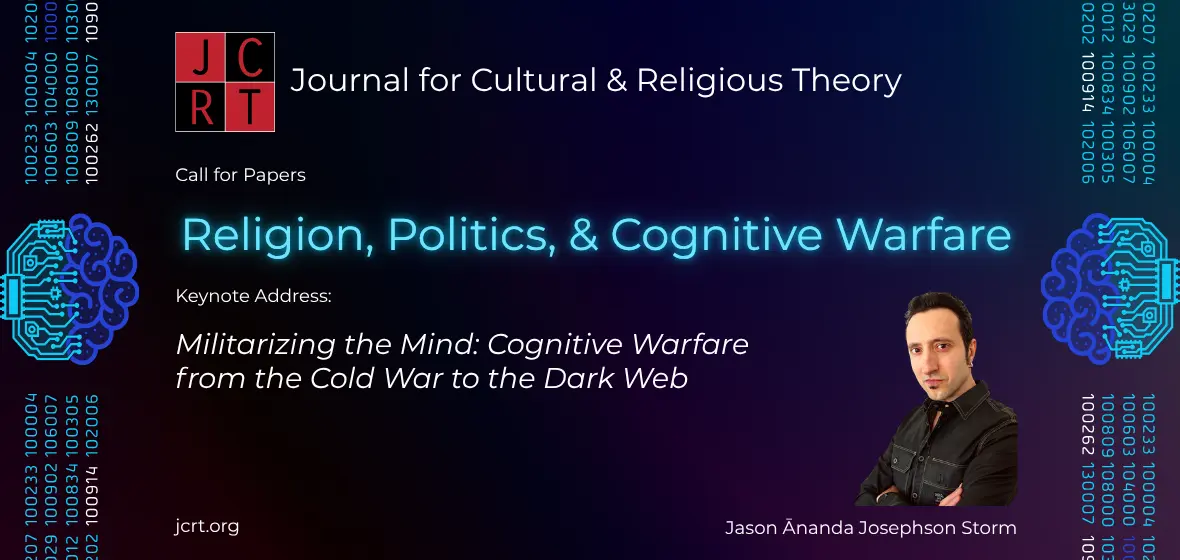
Religion, Politics, and Cognitive Warfare: Information, Interpretation, Conspiracy, and the Struggle for Reality
Details
- When: October 1-3, 2026
- Where: Online
- Registration: Now open
- Sponsored by: The Journal for Cultural and Religious Theory (JCRT) in collaboration with the University of Denver
This conference investigates how beliefs, paranoia, and conspiratorial modes of knowing shape a contemporary cognitive battlespace in which actors struggle to define truth, authority, and reality itself. Drawing on Michel Foucault’s Lectures on the Will to Know and Julia Kristeva’s This Incredible Need to Believe (2024), the event focuses on practices of selective fact use and “truth-selecting” that construct alternative epistemic orders while claiming privileged access to what is “really” going on.
Rather than treating conspiracy thinking as merely political or psychological, the conference foregrounds its religious dimensions: faith in hidden powers, moral dualism, apocalyptic expectation, and hermeneutical struggle over revelatory access to the real. Conspiracy cultures routinely reproduce theological structures of knowing—visions of salvation and corruption, truth and deception, initiation and blindness. At the same time, new forms of “cognitive warfare” reframe these religious energies within state and platform attempts to govern perception, attention, and trust. Artificial intelligence, algorithmic media, and strategic information campaigns do not only deliver messages; they create digital ecologies in which suspicion becomes faith-like and revelation is continual.
The conference organizers welcome contributions from scholars of religious studies, philosophy, communication, sociology, security studies, psychology, media, and related fields. We also encourage work that takes a reflective and analytical approach to both general and specific topics with international appeal or focus. Submissions should engage religion as a dynamic force—conceptually, historically, or materially—within the cognitive battlespaces of our time.
Keynote Address: Militarizing the Mind: Cognitive Warfare from the Cold War to the Dark Web
Jason Ānanda Josephson Storm
As I currently conceive it, the talk will open with three unsettling contemporary snapshots: a dark web occult repository of conspiracy theory screeds and “psychic mind-control” manuals; a NATO tactical statement declaring the human mind the “sixth domain” of warfare; and the familiar structure of a TikTok algorithmic rabbit hole. Together, these prismatic scenes suggest shared conceptions of the mind and a common repertoire of techniques for controlling perception, attention, and even thought itself.
The talk will trace the emergence of these conceptions of the mind to a Cold War military industrial complex and the convergence of cybernetics, psychic research, propaganda studies, and Soviet theories of reflexive control. From these entanglements emerged many of the psychological models and informational logics that continue to govern contemporary life. Engaging Han Byung-Chul’s “psychopolitics,” Bernard Stiegler’s account of the alienation of memory, N. Katherine Hayles’ account of virtual bodies, and Friedrich Kittler’s insight that civilian media infrastructures are basically sedimented military technologies, I will examine how modern systems of influence increasingly operate through feedback loops designed to capture attention, circumvent deliberation, and exploit fractures in epistemic authority and trust.
Jason Ānanda Josephson Storm is the Francis Christopher Oakley Third Century Professor of Religion, Chair of Science & Technology Studies at Williams College and author of The Genealogy of Genealogy: Nietzsche, Foucault, and the Coils of Critical History and Metamodernism: The Future of Theory.
Ahead of the keynote, Carl Raschke interviewed Josephson Storm read “Genealogy, Enchantment, and the War for the Mind”.
For a reading of Josephson Storm’s trilogy, see Adam DJ Brett’s essay “Theorizing the Human Sciences in the Age of Absolute Disruption: Historical Criticism and Its Remainders”.
If you have any questions please contact us at [email protected]
Please note in order to assist with the possiblity of supporting presenters into becoming authors each session will be recorded.
Conference Schedule
All times Mountain Daylight Time (Denver, UTC−6) unless labelled. Session block 08:00–12:30 MDT each day; two concurrent tracks used where needed.
Day 1 — Thursday, 1 October 2026
08:00 – 10:0009:0010:0007:0014:00Track APanel 1: Evangelicalism & Christian NationalismAndrew Robb-Scott
| Presentation | Presenter | Affiliation | City |
|---|---|---|---|
Eschatology as Cognitive Warfare: How Apocalyptic Theology Reshapes American Christian Nationalism's Truth Regime |
Dongfeng He | College of Liberal Arts, Jinan University, Guangzhou, China | Guangzhou · 22:00 local |
This paper proposes that contemporary American Christian Nationalism operates less as political theology and more as a cognitive warfare apparatus — a system in which apocalyptic eschatology is weaponized to restructure the epistemic architecture of political reality itself. Drawing on Foucault's Lectures on the Will to Know (2013) and Hofstadter's (1964) paranoid hermeneutics, I trace how Christian nationalist movements construct an alternative "truth regime" through selective scriptural citation, conspiratorial narratives of decline, and eschatological urgency recasting democratic deliberation as zero-sum cosmic struggle. Kristeva's (2009) "pre-religious need to believe" explains why apocalyptic narratives retain cognitive traction even as formal religious participation declines. The paper advances a three-dimensional framework of structural religious alienation, integrating the sociology of religion with critical theory to conceptualize how theological tropes are translated into assertions of sovereign power. First, at the level of faith ontology, salvation anxiety degenerates into a thirst for secular domination (Weber, 1946) — the theological category of "redemption" is repurposed as a mandate for institutional capture. Second, at the level of organizational form, the Durkheimian sacred born of collective effervescence corrodes into sectarian fanaticism (Durkheim, 1912/1995), transforming religious communities into disciplined political cadres. Third, at the level of discursive logic, theological revelation is reduced to what Marcuse (1964) termed "one-dimensional" language — a closed semantic system in which dissenting interpretations are preemptively coded as demonic deception. Drawing on Barkun's (2003) concept of stigmatized knowledge, I argue that apocalyptic eschatology functions as an epistemic gatekeeping mechanism: it claims privileged revelatory access to hidden realities while simultaneously delegitimizing secular knowledge production as epistemically corrupt — performing the dual cognitive warfare operations of truth-claiming and truth-invalidating in a single theological gesture. Empirically, I examine the Seven Mountain Mandate and Project 2025 as paradigmatic cases of this cognitive warfare strategy. The Seven Mountain Mandate — the theopolitical doctrine commanding Christian seizure of seven cultural domains (government, education, media, arts, business, family, and religion) — functions as a totalizing epistemic blueprint that recodes every institution as a battlefield in the war for truth. Project 2025 operationalizes this blueprint through personnel replacement, regulatory restructuring, and the weaponization of unitary executive theory, all within an apocalyptic temporality that generates theological justifications for political action beyond procedural democratic constraints. The paper contributes to the conference's inquiry into how paranoid styles and truth-selecting practices construct alternative epistemic orders by demonstrating that Christian nationalist eschatology performs precisely the function of a cognitive warfare doctrine: it provides a hermeneutics of suspicion that delegitimizes secular knowledge institutions, a moral dualism that transforms political opponents into cosmic enemies, and an apocalyptic expectation that normalizes theologically sanctioned departures from procedural democratic norms as a form of spiritual warfare. Methodologically, the paper introduces a comparative dimension rarely deployed in American-focused Christian nationalism scholarship. Juxtaposing the U.S. case — in which eschatological truth claims are embedded in state institutional design — with the Chinese constitutional model of church–state boundary regulation, the analysis isolates the institutional mechanisms through which apocalyptic theology crosses from private belief to public cognitive warfare infrastructure. | |||
Religion, Conspiracies, and Hate: Orthobros and Catholic Crusades on Social Media |
Carmen Celestini | University of Waterloo | Toronto · 10:00 local |
Instigated by the Great Replacement conspiracy theory, there is a rise in far-right Catholicism on social media, predominately under the Knights Templar Church. Using AI, memes, and images/clips from the film Kingdom of Heaven a movement, predominately young and male is being converted, and radicalized. Under a revisionist and romanticized version of the Crusades, antisemitic, anti-Islam, and anti-Protestant ideologies are spread, linking the role of maleness to "saving" faith, country, and family. Simultaneously Catholic Active Clubs are rising on social media, declaring "Christ is King" while training in the real world for the new crusades. Offline a trend of "Dressing Christian in Public" is being documented on social media, confronting the public with explicit Jesus themed clothing, or full Templar attire. Here individual priests, male laity, and Catholic influencers are blending conspiracies, far-right ideologies, and religion recruiting and spreading their ideologies. A multimodal analysis of Instagram, X, and Telegram posts, has found the key components of the appeal of this movement, the influence of the Great Replacement conspiracy theory inspiring hate and potential violent response, as well as the role of medieval conspiracism to mobilize both on and offline, while reigniting the cleavage between Protestantism and Catholicism in two versions of Christian nationalism. About the presenter: Carmen Celestini is a Lecturer in Religious Studies at the University of Waterloo, which awarded Celestini's PhD in Religious Studies. Celestini's research examines the overlapping belief systems of apocalyptic Christian thought, Christian nationalism, and conspiracy theories, and their effects on politics in North America. Celestini is co-author of The Canadian Far-Right and Conspiracy Theories (Routledge, 2025). ORCID | |||
Evangelical Discernment in the Age of AI |
Katelyn Zeser | Duke University | Washington DC · 10:00 local |
As evangelicals have risen to prominence in American politics, belief, conspiracy, and misinformation have also become increasingly enmeshed. Media technologies such as radio, film, and the written word each play key roles in buttressing the political and religious activities of these actors, who craft complex networks of religious authority, knowledge production, and claims to truth. These systems now collide with digital infrastructures, and the recent proliferation of artificial intelligence (AI) brings the ethical and political stakes of evangelical truth-seeking into sharp relief. Few evangelical media objects are as startling as those touched by AI, from Christian Zionist documentaries to Donald Trump's infamous self-portrayal as Christ. This paper explores the ways in which evangelicals evaluate the efficacy and appropriate uses of AI. Drawing from several months of online and in-person ethnographic fieldwork, I focus on the perspectives of the Christian tech professionals working to integrate AI into congregational spaces, spiritual practice, and missionary work. I show that my interlocutors do not embrace these technologies wholesale but actively negotiate their religious veracity through a deliberate process of revelatory, Spirit-driven discernment. In doing so, these developers seriously reckon with the ways AI could be co-opted or abused while also expressing deep excitement for how algorithms, text-to-image generators, and other AI tools can be leveraged “for the Kingdom.” Throughout the paper, I leverage ethnographic vignettes and media objects to show the dynamic—and at times paradoxical—ways my interlocutors approach their calling as AI evangelists. I explain how these believers work to build trust in AI through a discursive process that remains unsettled while they search for what God reveals to them about the machine. As they invent, design, and create their way towards God’s plan for artificial intelligence, the boundaries between propriety, ingenuity, and sacrilege remain ever in flux. The social relationships emerging between human, God, and machine in this process hold sweeping implications for the ways we might approach evangelical epistemic politics as a subject of cultural and religious inquiry. About the presenter: Katelyn Zeser is a PhD student in the Department of Cultural Anthropology at Duke University and holds a BA in Anthropology and Middle Eastern Studies from Dartmouth College. Her research examines the intersections of media, technology, and American evangelicalism, focusing on how artificial intelligence and other media technologies have reshaped the Christian Zionist media landscape in the United States since 2023. She is a 2026 recipient of a Duke Human Rights Center summer research grant. | |||
In The World But Not of it: Evangelical Epistemologies, Alternative Realities, and the Search for the Real |
Keven Lewis | Independent | Salt Lake City · 08:00 local |
The boundary between this world and the next has always been porous among those inheritors of American Evangelicalism (Boyer, 1992). From a predilection for interpreting global events with an eye toward an already/not yet eschaton; to founding think-tanks, educational institutions, and media empires that would far outlive their founders (Fitzgerald, 2017). From asserting the inerrancy and historicity of the Bible; to ascending Mount Everest to wage spiritual warfare, successfully unseating the “queen of heaven” (Ladner, 2026). Some might scandalize this progeny as out of touch, hypocritical, weird, “other.” Some may highlight the anxieties of modernity and the subsequent response to these extraneous conditions (Sutton, 2017). The aim of this paper is to, as Susan Harding implores to “interrogate representation itself” so that “we may ask how “fundamentalism” was invented, who speaks it, and what are the categories, assumptions, and trajectories implicit in its narrative representations” (1991). As such, this paper will consider how epistemologies among American Evangelicals have supplanted critical reason in exchange for the supranatural; and in doing so manufacture alternative realities. I will argue that the existence of these alternatives is not the result of a dismissal of what is real - rather, it is the consequential search for it - in the midst of an ever alienating world. I will go on to demonstrate how these realities are liable to nationalist myths, exploitation, and political manipulation. Finally, I will explore how these epistemologies depend upon an authority that is both out of reach but easily accessible; which, I argue, makes it especially malleable by propagandists and authoritarians in their pursuit of power. As I conclude I will examine the trajectories that are opened up as we consider the reality of these alternatives and their consequences on our shared democratic nation. About the presenter: Keven Lewis is an independent scholar who holds a B.A. in Anthropology, with minors in Religious Studies and Jewish Studies, and an M.A. in Liberal Arts from Middle Tennessee State University. Lewis's research examines how language enables evangelical Christians to cross imagined spiritual and social boundaries. | |||
09:00 – 11:0010:0011:0008:0015:00Track APanel 2: AI, Revelation & Religious AuthorityKev Grane
University of Denver/Iliff School of Theology
| Presentation | Presenter | Affiliation | City |
|---|---|---|---|
Sanad-less Knowledge: AI as an Epistemically Untrustworthy Mediator of Religious Authority in the Age of Cognitive Warfare |
Dr. Aysha Naeem | Virtual University of Pakistan | Islamabad · 20:00 local |
The Escalation of generative AI becomes a source of religious guidance, it fundamentally changes the way believers can access and validate religious knowledge. In the current era Complex theological issues can be answered instantly by platforms like ChatGPT, Quran GPT, Hadith GPT and other AI-powered fatwa chatbots, now offer instantaneous answers to complex theological questions, apart from trained scholars who have established verifiable chains of transmission (sanad) and whose answers are morally accountable. This change takes place in a digital environment that is defined by misinformation, polarization and systematic bias, and where misinformation about religious communities is perpetuated by machine learning models trained with biased data. In the current era of cognitive warfare, the research aim is to explore: what role can AI play in religious knowledge mediation? This research derives from the Islamic epistemological tradition that sees the authenticity of knowledge as being rooted in the chain of transmission (sanad), methodological criticism (naqd) and scholarly consensus, and thus distinguishes between the two different types of trust: epistemic trust suitable for the limited cognitive functions of AI and moral trust or religious trust which are the ones that AI lacks. The approach used is a qualitative synthesis of recent empirical research and theoretical work on the nexus of artificial intelligence, religious epistemology and cognitive warfare. The research comprises a keen analysis of AI generated religious content that mimics clerics' style of speech and conjures up sacred symbols, comparative overview of the epistemological trust of AI responses to religious questions with institutional fatwas, and the critical examination of works of scholarship about algorithmic authority, epistemological trust, and the transformation of religious authority in digital environments. This study has four implications. First, it shows that AI is not only the spreader of incorrect religious information, but it also changes how religious truth is identified, which is done away with technical accuracy and in favour of moral responsibility and the creation of what religious scholars describe as not authentic. Second, it shows how a new type of religious power is emerging: “algorithmic authority” and “infrastructure authority,” that supersede the traditional religious power of scholars with their quick and effortless religious answers which they perceive as objective knowledge. Third, it explains the transition from a system of epistemology to an epistemology of systems, in which the traditional hierarchy of authority has been undermined and computational legitimacy has become more significant. Fourth, and most importantly, the paper bridges epistemic crisis and cognitive warfare, wherein AI- generated religious content is increasingly being used as a weapon to undermine people's trust in society, create false authority, shape belief systems, and exploit religious divisions. The core theme of the research to revitalize digital literacy, algorithm transparency, community-driven fact checking and religiously informed ethics of technology to curb epistemic harm and reaffirm the importance of human scholarship in the transmission of religious knowledge. Keywords: Artificial Intelligence, Religious Authority, Epistemic Trust, Cognitive Warfare, Algorithmic Authority, Sanad, Religious Disinformation, Islamic Epistemology About the presenter: Aysha Naeem is a Lecturer in the Department of Islamic Studies at the Virtual University of Pakistan, a position held since 2023. ORCID | |||
AI Sacralization Tendencies in Zhihu User-Generated Content |
Aliona Ikonnikova | Vytautas Magnus University | Vilnius · 18:00 local |
This paper presents findings from a micro-ethnographic discourse analysis of AI-related content on Zhihu (知乎), China’s leading intellectual Q&A platform. Drawing on a purposively sampled corpus of 54 questions, answers, comments, and articles posted between 2023 and 2025, the study applies Razmetaeva’s (2023) eight-category typology of AI sacralization to examine how users employ religious and sacred vocabulary when discussing AI. The analysis identifies seven of the eight sacralization tendencies, with AI most frequently framed through quasi-divine attributes and as a source of authority. Users spontaneously employ concepts such as faith, theocracy, and spiritual intelligence, suggesting that sacralizing interpretations of AI emerge within the discourse itself rather than being imposed by the researcher. At the same time, the absence of the “sacrifice of privacy” category highlights the limits of applying Western-derived frameworks across different cultural contexts. The findings also reveal a tension in how AI is imagined: users describe it both as a radically non-human and impartial authority and as an intimate confidant capable of listening, comforting, and offering guidance. By tracing how religious language is mobilized around AI on a major Chinese platform, the paper explores emerging relationships between artificial intelligence, authority and belief. About the presenter: Aliona Ikonnikova is a researcher working at the intersection of religious studies, digital humanities, and East Asian thought. Ikonnikova holds a Master's degree in Contemporary Asian Studies from Vilnius University, with a thesis on AI sacralization discourse in China, and combines academic research with professional experience in software development and quality engineering. Research interests include AI ethics, digital religion, and religious minorities in Lithuania, including the Old Believers. ORCID | |||
US American Christian Imaginaries: The Aestheticization of Faith and Political Spectacle in AI-Generated Media |
Milo Miller | Leipzig University | Berlin · 17:00 local |
In April 2026, President Donald Trump posted an AI-generated image of himself, which has become somewhat standard fare for his social media presence. However, this particular image sparked backlash with his depiction as Jesus performing a healing miracle. In the proliferation of AI-generated media in social media spaces, representations of Jesus take on numerous forms across platforms and modes, from images to chatbots and beyond. This paper seeks to critically examine the aesthetic characteristics of AI-generated images featuring Jesus or a Christ-like figure, the mobilization of Christian imaginaries within US American conservative cultural productions, and the potential ramifications of these religiously-loaded ideological replications. In this research, I will read the selected AI depictions as cultural productions that utilize certain aesthetic qualities that both mark them as AI-generated and Christian through usage of recurring religious symbols and aesthetic markers. Centering the “cultural style of immediacy” as the mode through which I understand AI-generated media operating in these digital paranoid infrastructures, I will consider how such AI content troubles reality through its promise of immanent religious representation despite its own hypermediacy (Kornbluh, 2023). I will consider the cultural discourses that have contributed to and are reflected in these images through the homogenizing force of AI and thereby theorize on its paranoid symbolic infrastructure. In locating the cultural work which these images and their aesthetics are undertaking, I am interested in connecting this ongoing process of aestheticization with the commodification of the Christian faith. AI operates within a complicated digital environment as an increasingly present and seemingly autonomous social actor. Despite this perspective, it has been trained on certain data sets, guided by specific prompts, and used to reflect the worldviews and biases of the users and programmers (see, for example, Haghighi et al., 2025). Ultimately, these depictions are used as a means to gain social capital, stabilize conservative worldviews through uncritical replication (i.e., hegemonic power structures, racial hierarchies, conspiracy imaginaries, etc.), or otherwise justify extreme political agendas. Using this context, I will unpack this symbolic mobilization of Jesus through AI images in far-right worldbuilding or conspiracism in a US context. About the presenter: Milo Miller is a (post)doctoral candidate at the Institute for American Studies at Leipzig University. The project "Haunted Technology and Corrupted Nostalgia: Affect and Reality in New Media Horror" examines the aesthetics of AI-generated Christian imagery in US conservative media. | |||
Algorithmic Revelation: AI and the Temporal Conditions of Interpretation |
Adam W. Darlage | Oakton College | Chicago · 10:00 local |
Claims have traditionally earned the name of knowledge only slowly, through interpretation, testing, contextualization, and incorporation into communal memory. Artificial intelligence and algorithmic media disrupt this timeline because they do more than circulate information: they increasingly shape the temporal and interpretive conditions under which information comes to feel credible, meaningful, and even revelatory. I argue that artificial intelligence creates a digital environment in which knowledge appears instantly accessible, personally tailored, and detached from the slower practices that once tested and situated these claims. Within this environment, artificial intelligence does not just answer questions; it reshapes the timing of interpretation itself, encouraging judgments to form before competing explanations have had adequate time to emerge — precisely the conditions that cognitive warfare exploits. Religious traditions have long distinguished what they consider authentic revelation from competing truth claims through communities of interpretation, inherited texts, institutional authorities, ritual practices, and disciplines of discernment. Contemporary algorithmic systems answer to none of these: they generate an apparently continuous stream of personally relevant disclosures without requiring submission to any shared interpretive authority. Search engines, recommendation systems, social-media feeds, and LLMs respond instead to a user's own interests and prior assumptions, producing informational environments that can feel simultaneously intimate, coherent, and self-confirming. I examine the structural affinities between this kind of algorithmic personalization and religious or conspiratorial modes of revelation. To be sure, none of this means that artificial intelligence necessarily produces conspiratorial belief, or that religious revelation and algorithmic output are equivalent. Algorithmic environments nevertheless reproduce certain formal features of revelatory epistemology: hidden mechanisms, privileged access, personalized signs, pattern recognition, and the promise that apparently disconnected events can be assembled into a meaningful whole. These features become especially significant when combined with political polarization and declining institutional trust. Extending Berger's account of plausibility structures alongside Foucault on regimes of truth, Ricoeur on interpretation, and Kristeva on belief, I argue that algorithmic systems increasingly function as individualized plausibility structures, shaping not merely what people believe but how they come to regard particular interpretations as authoritative. In this way, algorithmic systems often grant confirming interpretations before competing explanations can be seriously entertained, compared, or tested. Suspicion is thereby transformed from a provisional hypothesis into a stable interpretive orientation—not because it has been conclusively demonstrated, but because opportunities for reflective comparison have been compressed. Cognitive warfare succeeds, on this account, not primarily by persuading individuals to adopt false beliefs, but by accelerating the process through which interpretations become settled. The result is a contraction of the interval between exposure, judgment, emotional commitment, and retransmission, a temporal condition that favors premature closure over reflective deliberation. I conclude that resistance to cognitive manipulation cannot consist solely of correcting false statements; it must also restore the temporal conditions of responsible judgment — delay, contextualization, interpretive friction, historical memory, and accountable communities of inquiry. The central struggle is therefore not only over which claims are true, but also over the temporal conditions under which human beings are able to exercise responsible judgment. About the presenter: Adam W. Darlage holds a Ph.D. in the History of Christianity from the University of Chicago Divinity School (2009). He teaches World Religions and World Mythologies in the Humanities and Philosophy Department at Oakton College in Des Plaines, Illinois. His scholarship includes work on early modern Anabaptism and Catholic Counter-Reformation in Moravia, published in Church History and The Catholic Historical Review. | |||
09:00 – 11:0010:0011:0008:0015:00Track BPanel 3: Islamic Epistemologies of VerificationJ.C. Smith
University of Denver
| Presentation | Presenter | Affiliation | City |
|---|---|---|---|
Tabayyun and Truth-Selection: Reconstructing Islamic Epistemology in the Age of Cognitive Warfare |
Maryam Nadeem | Independent Scholar | Lahore · 20:00 local |
The emergence of artificial intelligence, algorithmic media, and strategic information operations has transformed contemporary societies into cognitive battlespaces in which perception, trust, and interpretation are increasingly contested. Within these environments, truth is no longer merely discovered but selectively constructed through algorithmic curation, digital amplification, and competing claims to epistemic authority. Existing scholarship on cognitive warfare has largely examined these developments through the lenses of media studies, political communication, psychology, and security studies, while the potential contribution of non-Western epistemological traditions remains comparatively underexplored. This paper addresses that gap by examining the Islamic concept of Tabayyun (critical verification) as part of a broader Islamic epistemological framework for understanding knowledge, testimony, authority, and responsible interpretation. Rather than presenting Tabayyun as a normative solution to misinformation, the study investigates how it functions as a distinctive epistemic model that can critically engage contemporary debates surrounding truth-selection and cognitive warfare. The paper asks: (1) How does cognitive warfare reshape contemporary practices of truth production and epistemic authority? (2) How is Tabayyun situated within the wider framework of Islamic epistemology concerning verification, testimony, and ethical knowledge? (3) In what ways does this framework illuminate the religious and philosophical dimensions of truth-selection in digitally mediated environments? Employing a qualitative, interdisciplinary methodology, the study integrates conceptual analysis of classical Islamic epistemological sources with contemporary scholarship on cognitive warfare, digital media, and critical theory, engaging thinkers such as Michel Foucault, Han Byung-Chul, Bernard Stiegler, and Friedrich Kittler. It argues that Tabayyun constitutes not merely an ethical injunction but a coherent epistemological practice that foregrounds intellectual responsibility, evidential accountability, and disciplined judgment. By placing Islamic epistemology in dialogue with contemporary theories of cognitive warfare, the paper contributes a comparative framework that expands current discussions on religion, technology, and the struggle over reality while demonstrating the continuing relevance of Islamic intellectual traditions in analyzing modern crises of knowledge and trust. Keywords: Cognitive Warfare, Islamic Epistemology, Tabayyun, Truth-Selection, Epistemic Authority. | |||
Cognitive Warfare and the Maqāṣid al-Sharī'ah: Safeguarding 'Aql in the Age of Algorithmic Narratives and Epistemic Paranoia |
Abu Tayyab Luqman | Riphah International University, Islamabad, Pakistan | Rawalpindi · 20:00 local |
This paper investigates the emerging phenomenon of cognitive warfare—characterized by algorithmic narrative manipulation, dis/misinformation strategies, and psychological destabilization—through the teleological lens of Maqāṣid al-Sharī'ah. As modern digital architectures increasingly exploit cognitive vulnerabilities, traditional frameworks of information warfare prove insufficient to safeguard human autonomy and epistemic security. Grounded in classical Islamic jurisprudence and contemporary media theory, this study operationalizes the higher objective of Hifz al-'Aql (preservation of intellect) to formulate a proactive "Maqasidi Cognitive Framework." By positioning intellectual sovereignty as a fundamental normative right, the research examines how Islamic legal principles can mitigate algorithmic manipulation, counter epistemic paranoia, and foster critical digital discernment. The study concludes with practical governance recommendations for cultivating ethical digital resilience and protecting communal epistemic integrity in an era of asymmetric cognitive conflict. About the presenter: Abu Tayyab Luqman is a PhD research scholar in Islamic Studies at Riphah International University, Islamabad. He is a Senior Teacher of Islamiat and Tarjuma-tul-Quran at Al-Huda High School, Rawalpindi, and Khateeb of Jamia Masjid Muhammadi, Rawalpindi. His research interests include Qur'anic studies, Hadith, Islamic jurisprudence (fiqh), and contemporary ethical issues in Islam. ORCID | |||
When Rumor Becomes Judgment: Blasphemy Mobs, Social Media, and the Loss of Fiqh's Rules of Proof |
Shahid Hussain & Sahar Rajper | Bahria University, Karachi | Pakistan · 20:00 local |
In South Asia, blasphemy accusations increasingly skip the courtroom altogether. A rumor starts online, spreads within hours, and ends in mob violence before any judge, qazi, or state authority is even informed. Secular commentary usually explains this as religious fanaticism. This paper takes a different position: what collapses in these episodes is not restraint but method specifically, the rigorous evidentiary architecture that classical Islamic jurisprudence (fiqh) built around exactly this kind of accusation. What did Islamic law actually demand before it would allow a capital allegation to proceed? An unusually high bar deliberately so what did testimony (shahadah) require? Not just a witness present, but strict conditions of character, reliability, and consistency, tested and re-tested before any claim could stand. Hearsay carried little to no weight, no matter how confidently it was repeated. And what happened when there was even a single reasonable doubt (shubha)? The hadd punishment was suspended outright doubt didn't need to be resolved in the accused's favor to matter; its mere presence was enough to stop the process. These weren't minor procedural details. They were the whole point of the system, built specifically to stop exactly the kind of impulsive, emotion-driven verdicts we now see playing out on WhatsApp groups within a single afternoon. Modern platforms invert this. Feed algorithms are built to reward speed and outrage, not deliberation, and that incentive structure quietly replaces the qazi's careful weighing of evidence with something closer to a crowd vote. Reading this through Bernard Stiegler's account of technology as pharmakon both cure and poison alongside Michel Foucault's genealogy of the "will to truth," this paper treats social media less as a neutral messenger and more as an active participant that reshapes who gets to accuse, and how quickly an accusation becomes accepted fact. Consider how the pattern usually runs: a screenshot circulates often cropped, sometimes years old, occasionally fabricated outright and within that same news cycle it has already functioned as a verdict, not evidence. No isnad-style chain of verification, no cross-examination, nothing resembling shahadah. The image performs a certainty it was never actually shown to have. In effect, the accusation and the punishment start moving on the same timeline, with the deliberative gap fiqh insisted upon simply removed. There's a real irony sitting underneath all of this: the mob typically frames itself as defending sacred boundaries, while in practice dismantling the very legal tradition built to protect those boundaries responsibly. This paper isn't interested in relitigating individual incidents or assigning blame case by case. Instead, it asks a narrower and more useful question what happens to religious authority itself once evidence is replaced by velocity? And what would it mean, practically, to reassert fiqh's evidentiary standards inside a media environment explicitly designed to outrun them? Keywords: Fiqh, Islamic Jurisprudence, Social Media, Blasphemy Laws, Evidentiary Standards (Shahadah), Digital Infrastructures, Bernard Stiegler, South Asia. About Sahar Rajper: Sahar Rajper is an M.Phil. candidate and research scholar in Islamic theology at Bahria University Karachi. | |||
Algorithmic Compound Ignorance: Manufacturing Certainty in the Age of Cognitive Warfare |
Zohreh Ghaderi | External Researcher, Institute for Humanities and Social Studies, Academic Center for Education, Culture and Research (ACECR), Tehran, Iran | Tehran · 18:30 local |
Classical Islamic epistemology distinguishes simple ignorance (jahl basīṭ) — a mere absence of knowledge — from compound ignorance (jahl murakkab), a structurally deeper failure in which the subject is confident they already know. Compound ignorance resists correction precisely because it forecloses the moment in which doubt about one's own ignorance could arise. Historically, this was treated as an individual cognitive-moral defect — a failure of the particular knower. This paper introduces the concept of algorithmic compound ignorance to describe how algorithmic media transforms this classical individual liability into a structural output of the informational environment itself. Algorithmic systems optimized for prediction, personalization, and engagement need not deceive users about specific facts. Instead, they can continuously supply confirming evidence and reward certainty over inquiry, often reinforcing rather than exposing the conditions under which their own outputs might be falsified — manufacturing, at scale, an epistemic state classical logicians treated as a rare pathology of the individual mind. This has direct consequences for how we understand cognitive warfare: propaganda-era models built around "correcting misinformation" presuppose a felt absence of knowledge that prompts revision. Algorithmic compound ignorance produces no such absence. The contested terrain is not belief, but the second-order capacity to doubt one's own believing. This reframing also unsettles inherited models of distortion (taḥrīf), which presuppose an identifiable agent bearing moral responsibility for falsification. Algorithmic compound ignorance requires no such agent: it can emerge as a systemic output without any actor intending, or even foreseeing, the result — a structurally novel epistemic problem for both religious and secular accounts of moral responsibility. Drawing on classical logical sources on jahl murakkab alongside contemporary theories of algorithmic curation, this paper argues that algorithmic environments do not merely spread falsehood; they can systematically produce a form of epistemic closure structurally analogous to compound ignorance. This shift requires moving beyond misinformation-centered models of cognitive warfare toward an epistemological account of how algorithmic environments manufacture unwarranted certainty itself. About the presenter: Zohreh Ghaderi is an external researcher at the Institute for Humanities and Social Studies of the Academic Center for Education, Culture and Research (ACECR) in Tehran. Working in Islamic theology and the philosophy of religion, Ghaderi researches AI ethics, algorithmic distortion, and digital religion, and has published in Persian on the Qur'anic concept of nafs and on Islamic and Jewish theologies of predestination and free will. ORCID | |||
11:00 – 12:3012:0013:0010:0017:00PlenaryKeynote: Militarizing the Mind: Cognitive Warfare from the Cold War to the Dark WebChair: Carl Raschke
University of Denver
| Presentation | Presenter | Affiliation | City |
|---|---|---|---|
| Militarizing the Mind: Cognitive Warfare from the Cold War to the Dark Web See the keynote description above. |
Jason Ānanda Josephson Storm | Francis Christopher Oakley Third Century Professor of Religion and Chair of Science & Technology Studies, Williams College | Williamstown MA · 13:00 local |
12:30 – 14:3013:3014:3011:3018:30Track APanel 4: Communal Resilience & Counter-StrategiesCarl Raschke
University of Denver
| Presentation | Presenter | Affiliation | City |
|---|---|---|---|
Dusty Compasses in the Cognitive Battlespace: Institutional Values Delivery, AI Shortcuts, and the Hermeneutics of Faith Formation under Technological Acceleration |
David Roome | Eastern University | Pretoria · 20:30 local |
Modern institutional life has quietly become an expanded cognitive battlespace where human attention, discernment, and moral agency are continuously contested. In faith-based organizations, values-driven ethical frameworks designed as dynamic heuristic compasses routinely collapse under operational stress, calcifying into static dusty paperweights or decorative legalism. Existing accounts treat values-framework failure as theological formation or policy compliance; neither reads it as a problem of delivery architecture under cognitive load. Grounded in a micro-study of the Ethos Framework at Thomas More College in South Africa, this article synthesizes interdisciplinary fields of cognitive load theory, neuroeconomics, critical hermeneutics and James Fowler’s faith development theory to expose the formational costs of both top-down institutional mandates and the rising reliance on generative artificial intelligence. Under stress, finite working memory triggers least-effort heuristics, causing frontline actors to outsource their moral reasoning to fluent AI agents rather than navigate ideological complexity. Under high operational stress, practitioners are easily tempted by platform oracles that offer a frictionless alternative to deep moral reasoning. By generating immediate, virtue-simulating scripts that satisfy administrative demands, these systems execute an algorithmic shortcut that eliminates the desirable difficulties required for character formation and stalls adult faith development at Fowler’s Stage 3 Synthetic-Conventional conformity rather than advancing toward Stage 4 individuative-reflective conviction. Exacerbated by the Screen Inferiority Effect and a confidence paradox, this dynamic surrenders the cognitive domain to paranoid digital infrastructures. In response, this article constructs a relational counter-infrastructure in a Pace Compass Toolkit that draws on Southern African Ubuntu philosophy and an adaptation of the HAMER framework. By distributing cognitive weight through communal practices and preserving essential relational friction, this toolkit creates space for authentic mind renewal (Romans 12:2), and reclaims time for formation in an age of acceleration and platform governance. In doing so, it offers a practical path for institutions seeking to protect human moral agency against the quiet pressures of technological acceleration. About the presenter: David Roome is a PhD candidate in Professional Practice at Eastern University's Palmer Theological Seminary and a senior operations executive and enterprise systems architect with over 28 years of experience leading multi-country digital transformations. He holds an MPhil in Practical Theology from the University of Pretoria and a BSc in Chemistry from the University of the Witwatersrand. His doctoral research investigates barriers to value internalization under situational stress, at the intersection of computational technologies, adult learning, and organizational values. ORCID | |||
Sacred Publics: Cohesion Places as Antidotes to AI Enabled Cognitive Warfare |
Vera Marchand | ESSEC Business School | Paris · 20:30 local |
This paper reframes AI-enabled disinformation and hybrid influence as not only technical and political problems but as crises of communal sacrality: cognitive warfare dismantles the secular equivalents of religious institutions that historically produced shared meaning, ritualized verification and ethical orientation. In this paper, I argue that “cohesion places” - local journalism, schools, libraries, civic centres and community forums - function as secular liturgies and loci of revelation where epistemic authority is mediated, contested and ritualized. When algorithmic amplification and synthetic media convert suspicion into a faith-like paranoia, these civic sites are the principal bulwarks against the rise of conspiratorial hermeneutics. The paper develops three interlocking claims. First, conspiratorial and paranoid styles replicate theological structures - eschatology, moral dualism, claims to privileged revelation ; AI multiplies their reach by providing tools that mimic revelatory immediacy - deepfakes, microtargeting and automated swarms - thus converting private disclosure into public liturgy. Second, cohesion places enact communal practices - fact-checking as sacrament, deliberative forums as liturgy, pedagogical curricula as catechesis - that cultivate epistemic virtues, such as humility, patience, collective judgment and thus inoculate against truth-selecting and paranoid interpretation. Third, effective responses to cognitive warfare must therefore integrate technical governance - provenance metadata, watermarking, audits and regulatory sandboxes - with sustained investment in these quasi-religious institutions: durable funding for local media, curricularized media literacy, protected editorial spaces and civic infrastructures that restore habits of trust and shared narrative. Methodologically, the paper combines theoretical readings (Foucault’s will to truth; Kristeva’s analyses of belief), socio-technical analysis of AI-enabled influence practices and case studies demonstrating how localized civic rituals mitigated information crises. It interrogates donor and regulatory practices that instrumentalize media support, arguing that ethical media assistance should respect information sovereignty and function like pastoral care - supporting institutions that teach collective discernment rather than supplying instantatory narratives. The conclusion reframes policy as ecclesiology in civic form: preserving democratic deliberation requires treating local cohesion places as normative commons - sites where revelation is mediated, truth is communal work and citizens are formed against the temptations of conspiratorial faith. This religiously informed perspective offers theoretical and practical tools for decoding and countering cognitive warfare by restoring the social liturgies that sustain shared reality. | |||
Dialogical Resilience: Religious Discernment in an Age of Cognitive Warfare |
Gareth Evans-Jones | Bangor University | Manchester · 19:30 local |
Contemporary discussions of cognitive warfare have largely focused on the manipulation of information through artificial intelligence, algorithmic media, strategic misinformation, and synthetic content. While these analyses rightly identify the means by which beliefs are shaped, they often assume that cognitive warfare is primarily a battle over truth and falsehood. This paper argues that cognitive warfare is fundamentally a struggle over the ethical conditions of discernment itself. By encouraging simplified narratives, epistemic certainty, and forms of truth-selection that reward suspicion over dialogue, contemporary information environments reproduce dynamics long examined within religious traditions of interpretation. Recent scholarship and policy frameworks have responded through the concept of ‘cognitive resilience’. NATO, for example, argues that contemporary security requires protecting the human cognitive domain alongside physical and digital infrastructures, while interdisciplinary research has increasingly emphasised critical thinking, media literacy, and democratic resilience. However, these approaches remain predominantly psychological and strategic, paying comparatively little attention to the ethical and relational practices through which communities discern truth, negotiate disagreement, and sustain public trust. As such, this paper proposes ‘dialogical resilience’ as a complementary framework for resisting cognitive warfare. Dialogical resilience is the cultivated capacity to resist manipulative practices of truth-selection by remaining genuinely open to dialogue, critical judgement and moral responsibility. It aims to deepen existing models of cognitive resilience by foregrounding dialogue, ethical formation, and the shared practices that sustain democratic reasoning. To develop this account of dialogical resilience, the paper brings philosophical hermeneutics into conversation with contemporary debates on cognitive warfare, arguing that religious practices of discernment could offer distinctive ethical resources for democratic life. Drawing on Hans-Georg Gadamer’s account of understanding as a fusion of horizons, Paul Ricoeur’s hermeneutics of interpretation, Hannah Arendt’s conception of plurality and political judgement, and Bernard Stiegler’s analysis of attention and memory, it contends that listening is not passive reception but an ethical practice through which shared reality becomes possible. Contemporary information environments do not seek merely to influence what people think, but to reshape the conditions under which they attend, interpret, remember, and judge. Whereas conspiratorial epistemologies cultivate certainty through claims to privileged or hidden knowledge, Jewish and Christian traditions, at their best, cultivate attentiveness through dialogue, self-critique, and openness to correction. The paper argues that such traditions have long nurtured precisely these threatened capacities. The Shema (Deuteronomy 6:4–9), with its imperative, ‘Hear, O Israel’, places attentive listening at the heart of covenantal life, while havruta (paired study) and machloket l’shem shamayim (‘disagreement for the sake of heaven’) exemplify truth pursued through disciplined dialogue rather than ideological victory. Read alongside Abraham Joshua Heschel’s account of prophetic attentiveness, these traditions present listening as an ethical discipline of discernment. Within Christianity, the exhortation to be ‘quick to listen, slow to speak’ (James 1:19), Christ’s pedagogical practice of questioning, and traditions of lectio divina similarly cultivate attentiveness that resists haste, certainty, and manipulation. The paper concludes that these practices offer an overlooked model of dialogical resilience capable of strengthening democratic life amid cognitive warfare and epistemic fragmentation. About the presenter: Gareth Evans-Jones is Lecturer in Philosophy and Religion at Bangor University, where he co-directs the National Centre for Religious Education in Wales and the Centre for Pentecostal and Charismatic Studies. His research covers the Bible and slavery, Welsh Nonconformity and nineteenth-century religious print culture, Jewish-Christian dialogue, and literature and religion. He is the author of 'Mae'r Beibl o'n tu' (University of Wales Press, 2022), a study of Welsh-American religious responses to slavery, and an award-winning Welsh-language writer. ORCID | |||
News Numbers - Word Count Deviations, Impact and Cultural Values |
Dr. Char Sample | Marshall University | Charleston WV · 14:30 local |
Disinformation continues to wreak havoc on various free speech environments. Rapid countering of disinformation remains a significant challenge. Fact checking, while accurate is slow, thereby allowing the false narrative to take hold, inoculation is time consuming and requires a level of customization. What is really needed is an automated method to counter disinformation. AI has the computing power to quickly process news stories but lacks the necessary rules for discerning information accuracy. Computational linguistics provides a potential method for addressing the disinformation problem but, to date, progress has been limited. The approach discussed in this paper begins by characterizing linguistic features that associate with disinformation by cultural values. A link between culture and language exits but has limitations. Ten different global conflict regions were examined. Using AP News sources as the initial ground truth data measuring the distance from the ground truth becomes possible. Additional stories were gathered from local sources found in GDELT and social media along with the corresponding Vader values measuring emotional responses. This data as then examined within the context of Hofstede’s cultural values goal is to determine if the role of word count disinformation. A story that omits details is capable of influencing a reader. Similarly, a story that provides a narrative that can suggest an unvalidated reason for the news event. Thus, the word count in a news story provides a potential starting point for testing the first metric in the news numbers process for disinformation identification. The findings found mild to moderate correlations between word count and Vader values in conflicts that involved countries that tended toward restrained values, as well as holistic values which include long-term orientation. This finding suggests that automating the discovery of disinformation requires a finer tuned, culturally aware method to feed artificial intelligence engines instead of the broader criteria outside of cultural values. About the presenter: Char Sample is an Assistant Professor of cybersecurity in the Department of Computer Sciences and Electrical Engineering and a fellow of the Institute for Cyber Security at Marshall University. She previously held a senior cybersecurity research role with the Cybercore Integration Center at Idaho National Laboratory, and brings some four decades of industry experience. Her research focuses on cybersecurity, with an interest in decision-making. | |||
Day 2 — Friday, 2 October 2026
09:00 – 11:0010:0011:0008:0015:00Track APanel 5: Conspirituality, Esotericism & New Religious MovementsJ.C. Smith
University of Denver
| Presentation | Presenter | Affiliation | City |
|---|---|---|---|
Everybody Blames the Demiurge: Esoteric Hitlerism and Memetic Warfare |
Krushna Dande | PhD Scholar at Jawaharlal Nehru University | Delhi · 20:30 local |
This paper proposes to present the Chilean writer Miguel Serrano (1917-2009) as an exponent of the new religious movement Esoteric Hitlerism. We shall also trace the reception and transmission of Serrano's writings by a diffuse global neo-Nazi online culture, and the redeployment of his work in new battlegrounds of cognitive warfare. Serrano's work, overburdened with literary and historical allusion, has been memefied by neo-Nazi online culture, and emblems of Esoteric Hitlerism such as the Sonnenrad have appeared in manifestos of terrorist attacks at Christchurch, New Zealand, and Halle, Germany, in 2019. We intend to explore how esoteric and conspiratorial discourses are oriented in Serrano's work, and in its reception and retransmission, toward politically radicalising ends. Late in his life, after a long career as a diplomat and writer of mystical books, Serrano revealed that he had been a mystical initiate and a follower of Adolf Hitler. Serrano believed that Hitler had not died at the end of WWII, but rather had escaped into the hollow earth in a UFO to continue his cosmic war against the malevolent demiurge. Serrano elaborated his gnostic and eschatological cosmovision in a trilogy of books wherein he hailed Hitler as the last Avatar of Vishnu-Wotan, who had incarnated to reveal the true nature of the "concentration camp universe" by which Man is deceived. Serrano called on the Viryas, who were those with a blood memory of their extraterrestrial nature, to alchemically transmutate themselves to prepare for a final battle against the demiurge. As we may see, Serrano's religion is dizzying, syncretic, and polyvalent. Serrano constantly engages in selective use and interpretation of historical fact, and employs spurious genealogies to conflate myths of dozens of cultures whenever it suits his story. He also foregrounds his own privileged access to historical truth, whether by mystical initiation or by mundane diplomatic connection. All this amounts to an epistemic onslaught on the reader. How can such an evidentiary barrage be borne by a reader when the aggressor claims that consensus reality cannot be relied on? We may also see that such a dense and allusive set of religious texts also poses a problem for a neo-Nazi online culture that intends to inflame and radicalise at once and at scale. How has this culture redeployed Serrano's ideas as memes? How does the battleground of cognitive warfare differ in translation? About the presenter: Krushna Dande is a PhD scholar at Jawaharlal Nehru University, New Delhi, writing a doctoral thesis, "The Paranoid Universe: Science Fiction in Esotericism and Conspiracy," under Professor Saugata Bhaduri. Dande's earlier M.Phil. thesis at JNU, "Science Fiction as Cosmography," was awarded in 2022. Dande also writes on internet culture and memetic warfare, including an essay for Dilettante Army. | |||
Constructing Alternative Realities: Competing Regimes of Truth among Informal Esoteric Communities (Insights from Contemporary St Petersburg) |
Leontii Zhivotovskii | Independent Scholar | St Petersburg · 18:00 local |
Contemporary discussions of religion and cognitive conflict have increasingly focused on large-scale political narratives, conspiracy cultures, and digital information environments. Considerably less attention has been paid to the ways in which small-scale religious communities construct alternative regimes of truth through everyday ritual practice, shared interpretation, and localized myth-making. Drawing on eighteen months of participant observation, semi-structured interviews, and archival materials collected between 2024 and 2026, this paper examines several previously undocumented informal esoteric communities in contemporary St Petersburg as sites for the production of alternative realities. Rather than approaching these communities primarily as expressions of contemporary spirituality or Western esotericism, I argue that they are more productively understood as producers of distinctive epistemic frameworks. Their significance lies in reshaping the criteria through which participants distinguish truth from coincidence, authority from personal experience, and ordinary urban space from sacred landscape. Initiatory rituals, symbolic language, collective performances, and shared interpretations of the city gradually transform participants' cognitive maps, generating coherent interpretive frameworks. The paper introduces the concept of sporadic continuity to describe a mode of symbolic inheritance that operates independently of institutional succession. Unlike organizations claiming legitimate transmission from historical esoteric lineages, these communities derive authority through affective resonance with imagined traditions, literary narratives, urban memory, and fragmentary historical imagery. What is transmitted is therefore not institutional legitimacy but an epistemic disposition: a shared conviction that hidden structures of meaning remain accessible through ritual practice, intuition, and collective interpretation. Drawing on ethnographic case studies - including communities inspired by Russian Silver Age symbolism, reconstructed Dionysian motifs, vernacular spiritism, and contemporary Gnostic mythology - I demonstrate how these groups occupy a shared religious landscape in which competing interpretations of history, ritual efficacy, spiritual authority, and sacred space generate ongoing processes of rivalry and negotiation. Interactions between communities include efforts to challenge competing truth claims, reinterpret one another's symbolic systems, and recruit participants across community boundaries. These encounters show that alternative realities are produced not only within individual groups but also through their competition and interaction. Cemeteries, canals, abandoned buildings, and architectural landmarks function as active elements in the production of religious knowledge and collective identity. By shifting analytical attention from belief to epistemic practice, the paper argues that informal esoteric communities illuminate an underexplored dimension of contemporary religion. Rather than treating these groups simply as marginal religious formations, I propose understanding them as micro-social environments that both produce and contest competing frameworks for interpreting reality. In doing so, the paper contributes to current debates on religion, interpretation, and cognitive warfare by demonstrating how competing regimes of truth emerge through localized ritual practice, embodied participation, symbolic reconfiguration of urban space, and sustained interaction between alternative epistemic communities. About the presenter: Leontii Zhivotovskii is an independent scholar working at the intersection of art history, religious studies, and the study of esotericism. He holds a B.A. in History and Theory of Art from the Repin Institute of Arts in St. Petersburg. His current research explores esoteric visual literacy and the construction of insiders and outsiders in Northern European visual culture, c. 1600–1730. Alongside his historical work, he conducts ethnographic research on contemporary esoteric communities, examining initiation, symbolic language, group identity, and the modern reinterpretation of historical esoteric traditions. | |||
When in Doubt, It’s Mind Control: New Satanic Panic and the Conspiracy Survivor |
Marielle Hesselink | Heidelberg University (Germany) | Berlin · 17:00 local |
From Pizzagate and QAnon to the reception of the Epstein files release, the mass re-emergence of conspiracy theories about Satanic pedophile elites suggests we are amidst a “New Satanic Panic” (Klofstad et al. 2024). In this paper, I ask how conspiracist realities are legitimated and (not) believed by turning to a crucial figure within this re-emergence: the “conspiracy survivor,” whose recovered memories of Satanic Ritual Abuse (SRA) and mind control allow her to become living proof of a global conspiracy in lieu of material evidence, yet whose influence as a female conspiracy theorist is often overlooked in scholarship. Whereas the publication of Michelle Remembers (1980) launched self-proclaimed SRA survivor Michelle Smith and her psychiatrist Lawrence Pazder into television fame, today’s conspiracy survivor builds large social media followings while claiming authority as victim and expert rolled into one. With her testimony of gruesome mind control and sexual abuse, she links and authenticates a multitude of concerns to do with alternative knowledge, religion, and healing (Campbell 1972): she is a spiritual guide for those seeking to heal their own trauma; damsel in distress for the masculinist “pedo-hunter”; and evidence for those “doing their own research” on global conspiracies. Yet by comparing autobiographical material of a handful of such conspiracy survivors with their digital reception, I show that while verifying their followers’ conspiracist reality, these women simultaneously profess to endure a continuous cognitive conflict, doubting whether their memories of SRA and mind control are real at all. In an attempt to resolve this incongruity, these uncertainties are absorbed into the conspiracy itself. The doubts experienced by the conspiracy survivor must have been implanted by her alleged mind-controlling perpetrators—a notion that further intensifies the latter’s omnipotent malevolence yet never fully succeeds in dissolving the former’s base uncertainty regarding the reality of the conspiracy. I therefore argue that aside from embodying global conspiracies, the conspiracy survivor also personifies tensions between certainty and uncertainty, doubt and belief, that characterize contemporary conspiracism. About the presenter: Mariëlle Hesselink is a doctoral candidate in the Research Training Group "Ambivalent Enmity" (GRK 2840) at Heidelberg University, affiliated with the Heidelberg Centre for Transcultural Studies. She holds an MA in Transcultural Studies from Heidelberg University and a BA in Religious Studies from the University of Amsterdam. Her research addresses apocalyptic and millenarian movements and contemporary conspiracy culture. | |||
Awakening as Conversion Narrative: Conspirituality, Hidden Truths, and the Religious Imagination of Suspicion |
Jonathan Abernethy-Barkley | King's College London | London · 16:00 local |
This paper explores conspirituality and populist conspiracy cultures through the lens of conversion narrative, arguing that contemporary “awakening” discourse functions as a religiously inflected process of meaning-making, identity transformation, and communal belonging. Drawing upon Sociology of Religion, lived religion, digital religion, and political theology, the paper examines how individuals narrate entry into conspiratorial and conspiritual worlds using structures historically associated with religious conversion, revelation, and spiritual rebirth. Religious traditions have long negotiated the boundary between revelation and delusion, orthodoxy and transgression, sacred truth and hidden knowledge. Contemporary conspiritual movements similarly construct interpretive frameworks in which individuals claim privileged access to concealed realities through practices of symbolic decoding, selective interpretation, and suspicion toward institutional authority. In these contexts, “awakening” becomes both a spiritual and political act: a transformative moment in which individuals narrate themselves as having moved from blindness to insight, ignorance to truth, or conformity to resistance. The paper situates these narratives within wider global movements across the United Kingdom, United States, Germany, Australia, and Italy, examining how conspirituality circulates transnationally through digital networks shaped by populism, anti-elitism, wellness spirituality, and distrust of institutional expertise. Particular attention is given to how digital environments cultivate ritualised forms of participation through testimony, algorithmic reinforcement, symbolic interpretation, and communal storytelling. Theoretically, the paper engages Michel Foucault’s genealogy of the “will to truth,” alongside scholarship on conversion, apocalypticism, implicit religion, and collective identity formation. It argues that conspiritual awakening narratives mirror older religious hermeneutics in which hidden truths are accessible only to those who possess the correct interpretive framework. Within these communities, suspicion itself becomes morally valorised and spiritually legitimised. Rather than dismissing conspirituality as mere irrationality, the paper argues that awakening narratives should be understood as contemporary forms of existential and moral reorientation emerging within contexts of institutional distrust, social fragmentation, and epistemic instability. In doing so, the paper reframes conspirituality as a lived narrative practice through which individuals construct meaning, belonging, and alternative futures in late modern society. About the presenter: Jonathan Abernethy-Barkley holds a PhD from King's College London, awarded in 2025 for a thesis titled "The Relevance of Faith to Abuse: A Study of Lived Experience of Clerical Childhood Sexual Abuse within the United Kingdom," supervised by Ruth Sheldon and Linda Woodhead. His research addresses religion and lived experience, conversion narratives, and conspirituality. | |||
09:00 – 11:0010:0011:0008:0015:00Track BPanel 6: Religious Othering, Nationalism & ViolenceAndrew Robb-Scott
| Presentation | Presenter | Affiliation | City |
|---|---|---|---|
Ramayana and the Cognitive Battlespace: Mythic Authority, Narrative Power, and the Struggle for Reality in Contemporary India |
Soumya Sur | IIT Mandi | Mandi India · 20:30 local |
The figure of Ram occupies a uniquely contested position within contemporary India’s symbolic and political imagination. Far beyond the domain of devotional religion, Ram increasingly functions as a civilisational signifier through which competing actors negotiate legitimacy, morality, historical memory, and national identity. This paper examines how the Ramayana, as a continuously reinterpreted narrative archive, participates in what contemporary theorists describe as a “cognitive battlespace”: a struggle over perception, interpretation, and the authority to define reality itself. Drawing upon Michel Foucault’s notion of the “will to truth,” theories of soft power developed by Joseph Nye, postcolonial critiques of history and tradition associated with Romila Thapar, and the pluralist hermeneutics of A. K. Ramanujan and Sheldon Pollock, this paper argues that Ramayana traditions operate not merely as literary or religious texts but as epistemic frameworks that shape collective moral imagination. The endurance of Ram across centuries, languages, and regions reveals how mythic narratives become mechanisms for stabilising cultural memory and political legitimacy in moments of social uncertainty and ideological conflict. At the same time, the paper interrogates how selective invocations of Ram participate in contemporary processes of “truth-selection,” wherein competing groups mobilise sacred narratives to authenticate particular visions of nationhood, morality, and historical continuity. In digital and political spaces, Ram becomes simultaneously a site of reverence, contestation, symbolic mobilisation, and ideological projection. The paper therefore situates the Ramayana within broader global discussions on narrative sovereignty, religious symbolism, and cognitive warfare, asking how mythic figures are transformed into instruments of persuasion, identity formation, and civilisational legitimacy in the twenty-first century. Rather than treating Ram as either a purely theological figure or a straightforward political symbol, this study approaches the Ramayana as a dynamic interpretive field in which multiple realities, memories, and ethical claims compete for authority. In doing so, the paper contributes to current debates on religion, postcolonial identity, mythic memory, and the politics of interpretation in an age increasingly defined by informational conflict and struggles over epistemic legitimacy. About the presenter: Soumya Sur is a PhD scholar in English and Translation Studies in the School of Humanities and Social Sciences at the Indian Institute of Technology Mandi, with an MA in Literatures in English from the English and Foreign Languages University and a BA (Honours) in English from the University of Calcutta. Sur's work engages Indian kathā traditions and post-anthropocentric thought. ORCID | |||
Will to Know "Who Really Did It?": Religious Anxiety, Political Contestation, Everyday Life and the Anthropology of Ambiguity in the Post-Easter Sunday Bomb Attacks in Sri Lanka |
Anton Piyarathne | Department of Social Studies, faculty of Humanities & Social Sciences, the Open University of Sri Lanka | Colombo · 20:30 local |
The well-coordinated Easter Sunday bomb attacks occurred at three churches and three luxury hotels in 2019 in Sri Lanka did not simply produce competing explanations about a terrorist event, they created a continuing political field in which governments, opposition parties, religious leaders, investigative bodies, media organizations, and citizens continuously compete to establish authoritative truth. Anthropology here tries to investigate into "truth-selecting," that is, the method of employing selective facts to construct alternative epistemic orders. The protracted delay in concluding the investigation with broadly acceptable revelation of the truth and punishment for the wrongdoers eventually became a political resource. Through an anthropological perspective, this paper scrutinises how claims for truth revelation, calls for justice for the dead, political rumours and rhetoric become part of the everyday life that shapes inter-ethno-religious relationships, electoral politics, and public trust in Sri Lanka. This situation is a revelation of a shape of religion-based politics and ambiguity in South Asia and elsewhere in the world. This paper is based on a critical auto-ethnographic approach, synthesising the writer’s lived experience with newspaper content analysis and multi-ethno-religious survey data. The content analysis of the newspaper sources emphasises overwhelming public anxiety over the mysterious truth behind the Easter Sunday attacks, with many suspecting a "hidden hand" or political mastermind above Zahran Hashim, the leader of the terrorist group, and the Islamist group that launched the well-coordinated suicide missions. The Anthropology of Ambiguity' perspective this paper suggests is shaped by the Foucauldian study of the struggle for reality within a society where truth is constantly deferred. It examines how the 'will to know' “who really did it?”, often frustrated by the interference of mysterious 'hidden hands' connected to political elites and 'para-state' interference, drives a process of 'truth-selecting' that transforms religious anxiety and political rumours into the primary epistemic infrastructure of everyday life. Such delays worsen interethnic tensions, as unresolved grievances feed a "vicious cycle" of mutual radicalization among Buddhists, Christians, and Islamic extremists. Ultimately, elites weaponize this communal fear within a cognitive battlespace, prioritizing electoral mileage including regime change over national reconciliation as witnessed in many incidents. Amidst all these efforts and promises in everyday conversations at every doorstep, media conversations, parliamentary debates the vital question always repeated is “who really did it?" amidst references to various conspiracy theories continued to circulate, shaping the tensions and anxieties of the people, which has continuously challenged the peaceful coexistence of the multi-ethno-religious population of the country. The survey findings suggest the ways in which individuals negotiate these competing "truths" to make sense of their daily lives and construct a liveable daily life to meet their existential needs in multi-ethno-religious community in Sri Lanka within unresolved grievances, political rhetoric constantly generated, and political elites incite ethno-religious anxieties from time to time. About the presenter: Anton Piyarathne is Professor in the Department of Social Studies, Faculty of Humanities and Social Sciences, at the Open University of Sri Lanka, where he teaches sociology and anthropology. He holds BA and MA degrees from the University of Colombo and a PhD in Anthropology from Macquarie University. His research addresses ethno-religious conflict and reconciliation, religious ritual, and everyday life in Sri Lanka, and his books include Constructing Commongrounds: Everyday Lifeworlds Beyond Politicized Ethnicities in Sri Lanka (2018). ORCID | |||
“IN SPRINGFIELD THEY ARE EATING THE DOGS, THEY ARE EATING THE CATS”: THE NEGATIVE, RELIGION-BASED CONCEPTUALIZATION OF HAITIANS IN US POLITICS AS A WAY TO DEHUMANIZE THEM |
Antonio J. Pinto | University of Málaga (Spain) | Malaga · 17:00 local |
On September 10, 2024, the first debate between Democrat Kamala Harris and Republican Donald Trump, the candidates of the two major parties in the US presidential election held on November 5, took place. Hours earlier, Trump and his campaign advisors stirred up a familiar specter in the collective imagination of the average American voter: Haitian immigration. While, in general, US citizens tend to express distrust toward those who come from abroad, specifically from countries in the Global South, there is one particular migrant they not only resent but also fear: Haitians. It is precisely this nationality that has been targeted by Trump's latest outburst, in which he helped spread the false rumor that Haitians living in the state of Ohio had sown panic by kidnapping and devouring the pets of their respectable neighbors, specifically in Springfield—an example he explicitly cited in his speech. The average Republican voter probably will not stop to check the hoax spread by the propaganda machine surrounding the president-elect. Yet, the phenomenon that I have just described is not new: in the 1990s, in the middle of the humanitarian crisis that shook Haiti after the coup against Jean-Bertrand Aristide, which brought general Raoul Cedras to power, Haitian migrants were blamed for spreading HIV in the US. In the end, in both cases we see a negative conceptualization of Haitian migrants in the US, based on their religious beliefs and on their past insurrections against the established order, starting at the 1791 slave revolution that finished the plantation economy. My goal in this article is to explore the religious discrimination of Haitians, added to cultural and economic discrimination when it comes to blaming them for spreading diseases. I will define it as part of a strategy to dehumanize Haitians, depicted as “the others”, or as unhuman, thus justifying all kinds of abuses against them. About the presenter: Antonio Jesús Pinto Tortosa is Profesor Titular in the Department of Modern and Contemporary History at the University of Málaga. He holds a PhD from the Universidad Complutense de Madrid and CSIC (2012). His research covers the Haitian Revolution and Spanish Santo Domingo, the history of Spanish liberalism, industry and energy, urban history, and images of the United States. ORCID | |||
Hate against Religious Minorities in the United States: A Comparative Study of Muslim, Jewish, and Sikh Americans |
Fadime Apaydın | University of California, Riverside | Riverside CA · 08:00 local |
The United States (U.S.) is home to the largest number of immigrants globally, with over 40 million individuals (about 20% of the world's migrant population) born outside the country. Religion-based hate crimes are the second most prevalent type of hate crimes in the U.S. For example, in 2023, religious motivations were the driving force behind 22.75% of all hate crime incidents reported by the Federal Bureau of Investigation. The American Jewish, Muslim, and Sikh communities rank as the top three most frequently targeted groups in religion-motivated hate crimes in the U.S. Within this particular framework, the core aim of this research is to examine patterns of religion-motivated hate crimes in the U.S., based on the assumption that such acts of violence significantly impact the integration experiences of immigrant communities, with a particular emphasis on anti-Jewish, anti-Muslim, and anti-Sikh hate crimes. This analysis, based on data sourced from the Federal Bureau of Investigation's (FBI) Crime Data Explorer (CDE), an interactive platform of the Uniform Crime Reporting Program (UCR) that provides real-time access to disaggregated hate crime data, employs a range of quantitative indicators to examine the characteristics of hate crimes targeting Jewish, Muslim, and Sikh populations between 2015 and 2023 (from January 2015 to December 2023.) About the presenter: Fadime Apaydın is a Ph.D. student in religious studies at the University of California, Riverside, researching religion, politics, and cultural change at the intersection of global immigration and generational replacement, with a focus on Muslims in the United States. Apaydın holds an M.A. in Religious Studies from the University of South Florida and a B.A. in Religious Culture and Ethics Education from Ankara University, and has eight years of experience teaching religious education in Türkiye. ORCID | |||
11:00 – 13:0012:0013:0010:0017:00Track APanel 7: Sacred Geopolitics & State Cognitive WarfareKev Grane
University of Denver/Iliff School of Theology
| Presentation | Presenter | Affiliation | City |
|---|---|---|---|
Eurasianism – the Ideological Basis of Putin's Ruscism: the Protestant Context. |
Pavlo Pavlenko | Leading Researcher at the H.S. Skovoroda Institute of Philosophy of the National Academy of Sciences of Ukraine (Kyiv, Ukraine) | Kyiv · 20:00 local |
In contemporary Putin’s Russia, state ideology rests on Eurasianism — a socio-philosophical and geopolitical doctrine that ascribes to Russia an exceptional, messianic role in world history. The Russian Federation’s sharp anti-Western course, combined with the Kremlin’s imperial vision of Russia as “Eurasia” stretching “from Lisbon to Vladivostok,” and its systematic efforts to dominate the post-Soviet space, reveal a distinct fascist element of the Eurasian type in pro-Putin political discourse. Notably, Eurasianism in its original form (1920s–1930s) served as the ideological foundation of Russian fascism. Eurasianist thought is centered on the idea of a “closed, self-sufficient space” called “Russia-Eurasia.” Russia is portrayed as a unique “Eurasian super-ethnos” and a superpower existing in its own “special world.” Russians are presented as a new “God-chosen” and “God-bearing” people destined to fulfill a planetary humanitarian mission. At its core, Eurasianism is anti-Western, rejecting Western values as incompatible with Russian identity. Unlike the “Russian World” (Russkiy mir) ideology, which is rooted in Russian ethnocentrism and Slavophilism, Eurasianism views any exclusive focus on Slavophile traditions as harmful. It promotes instead a broader “cultural-continental unity.” While the “Russian World” relies solely on Russian Orthodoxy, classical Eurasianism interprets “Orthodoxy” more inclusively, regarding pre-Christian Russian paganism (Rodnovery) as “potential Orthodoxy” or “native faith.” Modern pro-Putin Eurasianism expands this concept even further by incorporating Protestantism. Evidence suggests that Vladimir Putin does not consider Russian Orthodoxy the sole “spiritual bond” (skrepa) of the state, although he effectively uses it as a tool for the reintegration of the post-Soviet space. Putin’s ideologues prefer Eurasianism because it appears more “empire-building” and operationally effective. Under Kremlin influence, a process of Eurasianization of Russian Protestantism is now actively underway. Protestant churches have begun adopting the Eurasian political worldview and launching pro-government projects. The transformation of Russian Protestantism from an evangelical movement into a Christian-political force is in its most active phase. This is clearly illustrated by Russian Pentecostalism. Its leader, Sergei Ryakhovsky, openly aligns with the Kremlin’s agenda and has expressed admiration for Aleksandr Dugin — the chief ideologist of contemporary Russian fascism and the main theorist of pro-Putin Eurasianism — describing him as “a man of high flight” capable of creating a modern Eurasian ideology. In implementing this project, Russian political Protestantism focuses particularly on Russian-speaking believers outside the Russian Federation. Through the promotion of the Russian language and pro-Russian thinking in both church and secular contexts in the so-called “near abroad,” Protestants in post-Soviet states are being turned into potential promoters of Eurasianism and carriers of Ruscist ideology in Christian packaging. Such developments are especially dangerous today, as Russia continues its war against Ukraine, which includes elements of genocide against the Ukrainian people. About the presenter: Pavlo Pavlenko is Doctor of Philosophical Sciences (Dr. habil.) and a Leading Researcher in the Department of Religious Studies at the H.S. Skovoroda Institute of Philosophy of the National Academy of Sciences of Ukraine in Kyiv. His research interests include early Christianity, Christology, biblical studies, religion and nationality, the philosophy of religion, and the political science of religion. His recent work addresses Protestant responses to Russia's war against Ukraine and the prospects of a post-war 'theology after Bucha.' ORCID | |||
The Battle for Reality: Sacred Genealogies, Escathological Myths and the Ontological conflict between the United and Iran in 2026 |
Aaron Rodriguez Sandoval | Erasmus Mundus-RED GLOBAL Master’s program researcher | Amsterdam · 19:00 local |
Contemporary discussions of cognitive warfare and cognitive domain operations are often presented as novel responses to an age of artificial intelligence, disinformation, algorithmic governance, and bias. Yet the conceptual architecture through which strategic communities understand cognition, conflict, and reality frequently reproduces much older theological and mythic structures. This paper argues that contemporary geopolitical strategic discourse remains deeply shaped by inherited religious epistemologies, particularly dualistic frameworks that divide the world into competing ontological orders, each claiming exclusive access to truth, historical destiny, and the fulfilment of the end of our contemporary times. Drawing on critical theory and religious studies, the paper explores how dominant geopolitical narratives universalize particular myths while rendering competing cosmologies irrational, archaic, or politically illegitimate. Rather than treating strategic discourse as an objective description of geopolitical reality, it approaches it as an ontological project embedded within a much longer genealogy of religious knowledge transmission. Narratives of civilization, empire, nation, and state can therefore function as secularized equivalents of older eschatological imaginaries in which history culminates in the triumph of order over corruption and evil. As a case study, the paper examines the enduring ontological confrontation between the United States and the Islamic Republic of Iran. Moving beyond conventional interpretations centred on security, ideology, or material interests, it traces the religious and mythic structures underlying competing geopolitical narratives, with particular attention to Abrahamic traditions and Persian-Zoroastrian cosmologies of cosmic struggle, purification, messianism, and the restoration of order. Through a critical historiographical reading of Persian intellectual traditions alongside contemporary geopolitical discourse, the paper examines how these structures have been transmitted, transformed, and secularized across millennia. The paper ultimately argues that cognitive warfare itself depends upon inherited assumptions concerning truth, the corruption of perception, epistemic purification, and ultimate victory. By exposing these continuities, it seeks to denaturalize concepts such as civilization, security, nation, and existential threat as historically contingent constructions rather than politically neutral realities. Cognitive conflict can thus be understood not merely as a contemporary technological phenomenon, but as the latest manifestation of much older struggles over ontology, historical meaning, and competing visions of epistemological finality. | |||
Theatrical-Theological Modeling and Prefigurative Worldbuilding |
Esther Marveta Neff | Independent | New York · 13:00 local |
In 2024, a Mossad spokesperson on the mainstream US news program 60 Minutes, stated that “we [Israeli intelligence] create a pretend world. We are a global production company. We write the screenplay. We’re the directors. We’re the producers. We’re the main actors. The world is our stage.” This paper draws on the theological and cosmological roots of “the theatre” to expose how the dominant colonial-modern logical space of Theatrum Mundi (world as stage, stage as world) authorizes and attributes the “theatrical agency” to produce “pretend worlds” in the first place. Colonial-modern political actors, from the Third Reich through anarchist protestors, have long weaponized Theatrum Mundi’s tripartite logics of theatrical modeling (representation, experimentation, and prefiguration), its division of roles (author, player, spectator), and its senses of cosmological isomorphism or “nested spheres,” in order to both enable and restrict “real” world-building abilities. In this paper, I will argue that it is Theatrum Mundi, and its “logics of relation,” which still distributes and determines the logical space for “pretend” (and more importantly, “prefigurative”) world-building across an expanded battleground for reality. About the presenter: Esther Marveta Neff is an interdisciplinary researcher, performance-maker, and adjunct professor working across performance studies, philosophy, theatre, and communications, with a PhD from the CUNY Graduate Center. Neff has directed Panoply Performance Laboratory, a performance philosophy thinktank and collective, since 2009, and their research focuses on modelling in the sciences and arts, neurodivergence and philosophy of mind, and epistemic justice. Neff's writing appears in the Routledge Companion to Performance Philosophy, and they compiled Institution is a Verb: A Panoply Performance Lab Compilation (2021). ORCID | |||
Drinking the Sand: Russkiy Mir, Limbic Hijack, and the Quasi-Religious Structure of Cognitive Warfare Operations |
Dennis Sullivan | The Astraea Initiative | San Diego · 10:00 local |
In The American President (1995), Aaron Sorkin’s protagonist observes: “They don’t drink the sand because they’re thirsty. They drink the sand because they don’t know the difference.” This paper argues that contemporary cognitive warfare operations are sophisticated sand-delivery systems—and that understanding them requires the theoretical resources of religious studies and critical theory as much as security studies or communications. More urgently, it argues that the solution requires something no post-authoritarian transition in the past century has invested in: teaching populations how to be free. Russkiy Mir (Russian World) is the primary case study because it represents the most fully articulated contemporary cognitive warfare system with complete quasi-religious architecture: sacred geography (Kyiv as the Jerusalem of Orthodox civilization); chosen trauma as founding myth (the Soviet collapse as civilizational crucifixion, operating through Vamik Volkan’s transgenerational mechanism); moral dualism (a Russophobic West versus authentic Russian civilization); initiatory knowledge (hidden truths Western media suppresses, matching Barkun’s “stigmatized knowledge”); and apocalyptic expectation (multipolarity as divinely ordained transformation). Our SPECTCT™ framework is politically agnostic—applicable wherever coordinated operations exploit degraded civic binding energy—but Russkiy Mir provides a uniquely complete specimen, satisfying the “incredible need to believe” (Kristeva 2024) that emerges when legitimate civic binding energy is systematically suppressed. The paper operationalizes SPECTCT™ (Sociological, Political, Economic, Cultural, Temporal, Cognitive, Technical) as an empirical detection architecture for identifying when quasi-religious epistemic structures are injected into target populations through coordinated information operations. Drawing on Foucault’s genealogy of the “will to truth,” it maps the emergence of alternative regimes of truth and distinguishes manufactured epistemic communities from organic ones through measurable signatures: velocity of belief formation (temporal), source coordination (technical), and targeting for Overton Window fragmentation (sociological). The underlying Kantian Event Horizon Theory conceptualizes κ—civic binding energy—as the substrate that renders populations susceptible when it degrades. The framework is applied to three documented cases: the “Narva People’s Republic” phantom operation in Estonia (targeting Western media rather than local populations); the Latgale R2P framing in Latvia (amplifying genuine minority grievances); and Russian nuclear signaling as limbic hijack, deploying existential dread below rational thresholds. In each case, SPECTCT™ analysis differentiates the quasi-religious epistemic architecture from the genuine vulnerability—the κ deficit—that makes it effective. The paper concludes by exposing a persistent failure in cognitive warfare discourse: the Paris 1944 template error. Post-authoritarian transition planning often assumes that removing an oppressive system will automatically release an underlying democratic substrate. France had such a substrate in 1944; post-Soviet Russia did not. Decades of Soviet rule destroyed horizontal trust, dismantled civil society, and encoded vertical dependency across generations. Nobody rebuilt the water supply. Russkiy Mir filled the void. Effective response therefore requires more than detection and counter-messaging. It demands civilizational substrate repair: rebuilding the civic foundations routinely neglected in favor of market mechanisms and governance templates. Freedom is not a latent condition revealed by removing tyranny; it is a cultivated capacity. Teaching populations how to be free is not a soft addendum to strategy. It is the strategy. About the presenter: Dennis J. Sullivan is Executive Director of The Astraea Initiative, based in Coronado, California. Sullivan's research addresses democratic peace theory, conflict prevention, and state coherence, including the Kantian Adaptive Networks Theory and the Kantian Event Horizon Theory. ORCID | |||
11:00 – 13:0012:0013:0010:0017:00Track BPanel 8: Paranoid Aesthetics: Literature, Film & HyperrealityCarla Christopher
United Lutheran Seminary
| Presentation | Presenter | Affiliation | City |
|---|---|---|---|
The Cinematic Revelation: Hollywood, Synthetic Images, and the Religious Hermeneutics of Suspicion |
Elie Yazbek | Saint-Joseph University of beirut | Beirut · 20:00 local |
This paper examines cinema as a central site in the formation of contemporary “truth-selecting” practices, arguing that Hollywood film has long functioned as a training ground for the paranoid and revelatory modes of knowing that now characterize the cognitive battlespace. Drawing on Michel Foucault’s account of the “will to know” and Julia Kristeva’s notion of the “need to believe,” I argue that cinematic spectatorship operates as a form of secularized hermeneutics in which viewers are invited to decode reality as if it were structured by hidden forces. Hollywood cinema—particularly in genres such as the conspiracy thriller and the “puzzle film”—repeatedly stages a world in which appearances deceive and truth must be excavated through suspicion. Films such as The Matrix (1999), Enemy of the State (1998), Minority Report (2002), and Inception (2010) construct narrative universes governed by invisible systems of control, where protagonists gain privileged access to a concealed layer of reality. More recent films, including Don’t Look Up (2021), extend this logic by dramatizing the collapse of epistemic authority and the fragmentation of shared reality under conditions of media saturation. These films do not merely reflect conspiratorial thinking; they formalize a mode of spectatorship that mirrors religious structures of initiation, revelation, and conversion. To theorize this dynamic, the paper places film theory in dialogue with thinkers such as Slavoj Žižek, whose work on ideology and cinema foregrounds the role of fantasy in structuring belief, and Jean Baudrillard, whose concept of simulation illuminates the instability of the image in late modernity. It also draws on Laura Mulvey’s account of visual pleasure and spectatorship to argue that cinematic looking is never neutral but structured by desire, projection, and interpretive framing. Together, these perspectives help explain how cinema trains viewers to see beyond the surface, cultivating a hermeneutics of suspicion that easily extends into conspiratorial modes of world-making. This cinematic trajectory culminates in a digital landscape where the traditional boundaries of the frame have dissolved into the expanded battlespace of cognitive warfare. With the rise of deepfakes and AI-generated video, the indexical link between image and reality—already destabilized in film theory—becomes increasingly untenable. In this environment, the "screen" evolves into what might be called a paranoid infrastructure: a visual field where images no longer guarantee truth but instead invite continuous interpretation, doubt, and belief. The spectator, accustomed to decoding cinematic illusion, becomes a participant in a broader epistemic struggle where reality itself appears as something to be uncovered behind layers of manipulation. Finally, the paper reflects on the ethical implications of this convergence between cinema and cognitive warfare. If contemporary subjects inhabit a world increasingly experienced as a film to be decoded, then the task of criticism is not simply to debunk false images but to understand the enduring appeal of revelation itself. By situating Hollywood cinema within these religious and epistemic dynamics, this paper argues that the struggle for reality today is inseparable from the cinematic forms through which it is imagined and lived. About the presenter: Elie Yazbek is a professor and director of the Doctoral School in Human and Social Sciences at Saint Joseph University of Beirut, where he previously directed the Institute of Theatrical, Audiovisual and Cinematographic Studies (IESAV) from 2011 to 2020. He holds a PhD in cinema studies from the Sorbonne and teaches directing and film theory. His research addresses cinema, media, and Hollywood, including blockbuster soft propaganda and new media coverage of war. ORCID | |||
Extra Conspirationem Nulla Salus: Hyperreal Religion, Paranoid Salvation, and Truth-Selecting in the Polycrisis |
Dirk Jochen Netter | Marburg University | Berlin · 19:00 local |
Contemporary polycrisis (Rakowski et al., 2025, p. 176) displays what Beck (1992, pp. 75–76) already predicted in his theory of his “risk society”: its stochastically distributed risks are increasingly invisible, while the consequences of entangled crises degrade social and political systems, become increasingly difficult to ignore. At the same time, decisive threats can no longer be witnessed directly but become only accessible through competing scientific and counter-scientific interpretations. This condition intensifies what Berger et al. (1974, p. 82) describe as modernity’s deepening metaphysical “homelessness”: the loss of a sense of ““being at home” in society, with oneself and, ultimately, in the universe”, accompanied by a longing for such a condition. Individualisation has loosened the boundaries and obligations once imposed by society, expanding the range of possible identities and beliefs. Yet the erosion of these inherited structures also weakens the sources of certainty and belonging they once provided. This paper argues that these circumstances create favourable conditions for the appeal of conspiratorial meaning systems as attempts to reconstruct (at least in part) a metaphysical home. QAnon is taken as an ideal-typical case of how quasi-religious movements perform religious work and is conceptualised as a hyperreal religion adapted to late-modern markets of meaning. These movements locate evil in hidden forces operating outside the imagined true community (Barkun, 2013, pp. 3–4). Berger’s sociology of religion (Berger, 1967, 1984, 2008) and Berger and Luckmann’s theory of the social construction of reality (1966, p. 180) is then discussed as an instrumentarium for analysing how these alternative structures of relevance (Barkun, 2015) are adopted and how a knowledge system that (might) appear implausible to outsiders becomes subjectively real. As consumer markets individualise commodities, these movements individualise (an implicit promise of) salvation through combinations of political suspicion and ‘spiritual awakening’. Ward and Voas (2011, p. 104) concept of ‘conspirituality’ captures this configuration particularly well: building on Barkun (2013), they describe it as the fusion of conspiracy belief with an anticipated transformation of consciousness – while delivering the immediate and this-worldly promise of ‘awakening’ and liberation from manipulation. A quasi-soteriological structure illustrates QAnon’s relation to religion. While for example the collective interpretation of revelatory texts (such as ‘Q drops’) is structurally analogous to lay exegesis, at the same time QAnon lacks the important factors commonly associated with religious movements (Foertsch et al., 2024, pp. 75–76). The resistance to established classifications suggests its conceptualisation as a hyperreal religion: unlike earlier new religious movements, it is not tethered to the reality principle (Baudrillard, 2019, p. 13) in the same way, but operates through a fluid assemblage of signs and political interpretations. Finally, the distinction between orthodoxy and heterodoxy helps locate these knowledge systems within a contested field, but does not determine their epistemological status or capacity for revision (Bourdieu, 2010a, p. 473, 2010b, p. 164). It must therefore be supplemented by epistemic revisability as a second criterion, which distinguishes a knowledge system’s doxic status from its openness to correction. Literature: Barkun, M. (2013). A culture of conspiracy: Apocalyptic visions in contemporary America (Second Edition). University of California Press. Barkun, M. (2015). Conspiracy theories as stigmatized knowledge. Diogenes, 62(3–4), 114–120. doi:10.1177/0392192116669288 Baudrillard, J. (2019). Simulacra and simulation (S. F. Glaser, Trans.). Univ. of Michigan Press. Beck, U. (1992). Risk society: Towards a new modernity. Sage Publications. Berger, P. L. (1967). The sacred canopy. Berger, P. L. (1984). The Sociological Study of Sectarianism. Social Research, 51(1/2), 367–385. Berger, P. L. (Ed.). (2008). The desecularization of the world: Resurgent religion and world politics. Ethics and Public Policy Center. Berger, P. L., Berger, B., & Kellner, H. (1974). The homeless mind: Modernization and consciousness. Vintage Books. Berger, P. L., & Luckmann, T. (1966). The Social Construction of Reality: A Treatise in the Sociology of Knowledge (New Ed Edition). Penguin. Bourdieu, P. (2010a). Distinction: A social critique of the judgement of taste. Routledge. Bourdieu, P. (2010b). Outline of a theory of practice (Nachdr.). Cambridge Univ. Press. Foertsch, S., Chakraborty, R., & Joosse, P. (2024). Asymmetric conflation: QAnon and the political cooptation of religion. Politics and Religion, 17(1), 58–80. doi:10.1017/S1755048323000275 Rakowski, J. J., Schaan, L. N., Klink, R. van, Herzon, I., Arth, A., Hagedorn, G., Rode, J., Creutzig, F., & Pe’er, G. (2025). Characterizing the Global Polycrisis: A Systematic Review of Recent Literature. Annual Review of Environment and Resources, 50(Volume 50, 2025), 159–183. doi:10.1146/annurev-environ-111523-102238 Ward, C., & Voas, D. (2011). The Emergence of Conspirituality. Journal of Contemporary Religion, 26(1), 103–121. doi:10.1080/13537903.2011.539846 About the presenter: Dirk Netter is a doctoral candidate at the Institute for Educational Science, Philipps-Universität Marburg. Netter's research addresses post-truth politics, conspiracy theory, epistemic closure, and radicalization, and how education in democratic contexts can respond to misinformation. ORCID | |||
The Penis—Oops, Sun—Also Rises: Hemingway’s Great War; Trumpian Great Replacement |
Sheng-mei Ma | Prof of Eng, Michigan State Univ | Detroit · 13:00 local |
The supremacy of white phallicism arises on the backs, over the dead bodies, of diseased and deceased nonwhites. Before Jake Barnes lost his manhood and could not consummate with Lady Brett Ashley in The Sun Also Rises (1926), Ernest Hemingway’s alter ego Nick Adams had received his “primal wound” from the betrayal of the “squaw” Prudence Mitchell in “Ten Indians” (The Nick Adams Stories 29). Before the matador Romero (Romeo? Eros?) had “the [bull’s] horns pass him close each time” (124), Nick had already suffered his early brush with death in the 1924 story “Indian Camp” when he asked: “Is dying hard, Daddy?” in the wake of an Indian slitting his own throat (21). Hemingway’s Lost Generation of American expats in European cafés turns out to have found(ed) itself as early as Nick Adams’s traumas amid Indians in Michigan’s woods. A century later, coinciding with the United States Semiquincentennial, Trump’s conspiracy theory of the Great Replacement by people of color, not to mention the “CHINESE Virus” from the Trumpian caricature of “CHY-NA,” stems from, likewise (wise?), MAGA ressentiment and revanchism over felt loss of white privilege, birthright even. “Make America Great Again!” encrypts “Make America White Again,” as though it has ever stopped being so. The phallic fetish is shared by Barnes castrated by the Great War and by the Great White Hope in the White House of the White Promised Land. Between the two American Greats one century apart, hardening and erecting, respectively, in the pantheons of world literature and of world politics, the interim idleness lying within the titular semicolon recharges white supremacy from the Holy Spirits of Genesis, Freud, and sci-fi saviors. Keywords: The Sun Also Rises, Hemingway, Trumpism, whiteness studies, people of color, conspiracy theory of race About the presenter: Sheng-mei Ma is Professor of English at Michigan State University, specializing in Asian diaspora culture and East-West comparative studies. He is the author of over a dozen books, including Chinese Serial (2026), Cultural Bifocals (2025), China Pop! (2024), The Tao of S (2022), Off-White (2020), and The Deathly Embrace (2000), and co-editor of five books and special issues. ORCID | |||
“The Manchurian Candidates: Lockean Epistemology and Cognitive Programming” |
Dr. Mark Thompson | University of North Texas (Dallas) | Dallas · 12:00 local |
Half a century ago, Richard Hofstadter famous described a peculiar way of looking at the world as a “paranoid style.” This study into the “American Mind” was prompted by his experience living in the United States during the cold war. It was a sensibility for a minority of people, an exaggerated way of seeing the interconnection of events, yet not merely neurotic but embraced by “normal” people throughout the nation’s history. Today, what has changed? Richard Condon’s The Manchurian Candidate (1959) and John Frankenheimer’s later film (1962) reveal how the legacy of Lockean empiricism continues a fruitful discourse about epistemology, specifically the nature and limits of knowledge, an important subject for comprehending the paranoiac and conspiratorial mindset. Additionally, the ambiguous status of “ideas” (another legacy from Locke) ensured that topics associated with brainwashing, such as “planting ideas,” would remain fuzzy and obscure. The Enlightenment promised to create the “rational” human, a morally superior version of his/her older, primitive self. This confidence was predicated on the increase in knowledge available to those countries participating in the “republics of letters.” Recent criticisms of the Enlightenment Project, such as the writings of political philosopher John Gray, reaffirm the pessimistic tendency to doubt that human nature is both perpetually malleable and without essence (as the Existentialists contend). The Manchurian Candidate (both novel and film) continues this declension narrative and shows that all humans are candidates for brainwashing as we plant ideas and manipulate people for various ends. In particular, Karl Mannheim’s contention that ideology is not bound to specific groups and Gordon Wood’s insights from his seminal article on the relationship between causality and naturalism still command attention: all citizens—be they soldiers, scientists, senators—are conspiracy theorists: we all think about and are prompted by scientific discourse to stress natural explanations that lay behind events. About the presenter: Mark Thompson is adjunct faculty in History and Political Science at the University of North Texas at Dallas. | |||
Day 3 — Saturday, 3 October 2026
09:00 – 11:0010:0011:0008:0015:00Track APanel 9: Hermeneutics, Truth & Responsible BeliefRobert Spinelli
Independent Scholar
| Presentation | Presenter | Affiliation | City |
|---|---|---|---|
The Weaponization of Hermeneutics: Religious Interpretation as Cognitive Warfare in the Digital Public Sphere |
Qursam Fatima | Lecturer | Faisalabad · 20:00 local |
The current debates regarding cognitive warfare have largely focused on disinformation, propaganda, cyber operations, and artificial intelligence as mechanisms for influencing public opinion. Comparatively less attention has been given to the role of religious interpretation itself as a strategic site of cognitive contestation. This paper argues that in the digital public sphere, hermeneutics has undergone a significant transformation: from a scholarly and theological practice of meaning-making to a mechanism through which political actors, digital platforms, influencers, and online communities compete to shape collective consciousness, social identity, and public reality. Rather than viewing religious texts and symbols as static sources of meaning, this study conceptualizes interpretation as an arena of epistemic struggle where competing narratives seek legitimacy, authority, and political influence. Drawing upon philosophical hermeneutics the paper develops the concept of weaponized hermeneutics. This concept explains how religious meanings are strategically reframed, and circulated through algorithmically mediated digital environments to influence perception, reinforce ideological commitments, mobilize political identities, and normalize competing constructions of reality. The paper contends that the principal battleground of contemporary cognitive warfare is not merely information, but interpretation itself. Information acquires political and social force only through interpretive processes that shape what communities accept as truth, authority, and moral legitimacy. Employing a qualitative conceptual and interdisciplinary approach, this paper critically synthesizes literature from religious studies, sociology, political theory, media studies, and communication research to propose a new analytical framework for understanding the intersection of religion and cognitive warfare. Rather than treating religion solely as a target or victim of information disorder, the study demonstrates how interpretive practices surrounding religious narratives can become strategic instruments within broader political struggles over reality. The paper contributes to contemporary debates by shifting scholarly attention from information warfare to interpretive warfare, arguing that the struggle for cognitive dominance increasingly depends on controlling the frameworks through which individuals and communities interpret religious meaning. By positioning hermeneutics as a central analytical category in the study of cognitive warfare, the paper offers a novel interdisciplinary perspective on the relationship between religion, politics, digital media, and epistemic power. In doing so, it provides a timely theoretical contribution to ongoing discussions concerning information, interpretation, conspiracy, and the contested production of reality in the twenty-first century. | |||
Many-Sided Realism against Paranoid Closure: Anekāntavāda, the Will to Truth, and the Cognitive Battlespace |
Iqbal Akhtar | Florida International University | Miami · 11:00 local |
Conspiracy thinking, this paper argues, is best understood not as a surplus of suspicion but as a deficit of perspective—an epistemology of closure. The paranoid style promises that a single hidden key unlocks all events: one occulted agent, one master narrative, one totalizing standpoint from which the real is finally seen whole. In the vocabulary of classical Jain philosophy, this is ekānta, the one-sided absolutism that mistakes a partial standpoint (naya) for the whole of its object. The “truth-selecting” the conference identifies as constitutive of contemporary cognitive warfare is, on this reading, a naya that has forgotten that it is one—a viewpoint elevated to sovereignty over reality itself. Against this closure, the paper mobilizes the Jain doctrines of anekāntavāda (non-onesidedness) and syādvāda (conditional predication) as a religious-philosophical grammar developed precisely to resist epistemic totalization. Where the conspiratorial hermeneutic demands that every fact resolve into a single occulted intention, anekāntavāda holds that truth is irreducibly perspectival, that any object admits multiple valid yet partial characterizations, and that the disciplined response to seemingly inconsistent claims is not their synthesis into one master account but their qualification (syāt, “in a certain respect”). The saptabhaṅgī, or sevenfold predication, formalizes a refusal to collapse plurality into a single revelatory verdict—a refusal that functions as spiritual discipline, not merely logical technique. This framing permits a re-reading of Foucault’s genealogy of the “will to truth” from a non-Western vantage. Foucault traces how the will to know installs itself as a will to truth that governs what may count as real; anekāntavāda names the answering vice—the appropriative desire to possess reality from one standpoint—and prescribes ascetic countermeasures against it. Conspiracy culture’s theological architecture of hidden powers, moral dualism, and initiation versus blindness thus appears as ekāntic religiosity: revelation without remainder. Many-sided realism, by contrast, sanctifies remainder, the always-more that no single standpoint can exhaust. The paper concludes by proposing anekāntavāda as a resource for a counter-hermeneutic within the cognitive battlespace—not a relativism that abandons truth, but a pluralism that disciplines the will to possess it. Situated within the author’s broader work on covenantal pluralism, this is advanced as a theologically serious alternative to both credulous suspicion and positivist debunking: an epistemology adequate to a moment in which revelation has become continual and reality itself contested. About the presenter: Iqbal Akhtar is Associate Professor with a dual appointment in Religious Studies and Politics and International Relations at Florida International University, where he directs the Jain Studies Program. He received his PhD from the University of Edinburgh, and his research spans Khōjā studies, Western Indian Ocean studies, Sindhi and Gujarati Islamic literature, postcolonial thought, and Islamic studies. He is the author of The Khoja of Tanzania: Discontinuities of a Postcolonial Religious Identity. ORCID | |||
The Struggle for Reality: Digital Culture & the Conditions of Responsible Belief |
George Twohig | Marquette University | Chicago · 10:00 local |
Contemporary discussions of cognitive warfare often focus on misinformation, conspiracy, and the strategic manipulation of belief. This presentation argues that the deeper struggle concerns the conditions under which responsible belief becomes possible at all. Digital platforms, algorithmic systems, and artificial intelligence increasingly mediate attention, plausibility, interpretation, and authority, reshaping how we come to judge what is credible and true. Drawing on Michel Foucault, Charles Taylor, Bernard Lonergan, and Josef Pieper, the presentation develops a layered account of belief formation. Foucault illuminates the organization of knowledge and authority; Taylor the social conditions of plausibility; Lonergan the cognitive operations required for responsible judgment; and Pieper the receptive and contemplative conditions necessary for genuine attentiveness. Together, they suggest that contemporary digital culture can weaken both the cognitive labor and contemplative leisure upon which responsible assent depends. Cognitive warfare should therefore be understood not only as a contest over information, but as a struggle over the formation of subjects capable of attending, interpreting, judging, and assenting responsibly. Preserving human agency within digitally mediated environments requires recovering these practices of responsible knowing. About the presenter: George Twohig is a graduate student in the Department of Theology at Marquette University. ORCID | |||
The Threshold Not Even God Can Cross: Perceived Determinacy and The Reality of Underdetermination. |
Christopher A. Ray | Vanderbilt Divinity School | Nashville · 10:00 local |
This paper asks why deeply held religious, ideological, and conspiratorial beliefs become publicly authoritative despite persistent interpretive disagreement. I argue that contemporary cognitive warfare exploits the gap between perceived determinacy and the reality of interpretive underdetermination. Drawing on Michel Foucault’s account of truth production, Julia Kristeva’s analysis of the human need to believe, and contemporary hermeneutical theory, I show that private certainty and public legitimacy are fundamentally different epistemic conditions. To explain this distinction, I introduce the concept of the Public Determinacy Threshold (PDT), a criterion for evaluating when competing interpretations can legitimately ground publicly coercive authority. Human beings do not encounter reality directly but through interpretive frameworks mediated by language, culture, memory, institutions, and tradition. Consequently, the same phenomenon can generate multiple internally coherent interpretations, producing a condition of persistent hermeneutical underdetermination. At the same time, psychological pressures associated with uncertainty encourage the formation of internal stabilizing frameworks that transform ambiguity into perceived certainty. This dynamic helps explain the enduring power of religious revelation, conspiracy narratives, ideological commitments, and other systems of meaning. Such frameworks often provide cognitive and existential stabilization by organizing experience into coherent realities that appear self-evident from within the interpretive community. Cognitive warfare exploits this condition by contesting not merely facts but the frameworks through which facts acquire meaning, authority, and legitimacy. The Public Determinacy Threshold provides a criterion for determining when competing interpretations can legitimately ground publicly coercive authority. It defines the minimum condition under which such claims can be publicly evaluated without requiring prior acceptance of the contested interpretive framework. While private certainty may be psychologically compelling and existentially meaningful, claims that remain interpretively underdetermined cannot automatically generate publicly legitimate authority. The problem confronting pluralistic societies is therefore not belief itself, but the conversion of privately justified certainty into publicly coercive authority under conditions of persistent underdetermination. This paper concludes that the central challenge of contemporary cognitive warfare is not the existence of competing realities but the attempt to transform perceived determinacy into socially binding truth. Cognitive warfare exploits the tension between perceived determinacy and the reality of underdetermination. Democratic legitimacy therefore depends upon maintaining standards of public justification capable of distinguishing private conviction from publicly authoritative claims. The threshold separating those domains is one that no claim, including claims of revelation, can cross merely by virtue of certainty alone. | |||
Faith, Fear, and the Comment Section — How Antisemitism and Conspiracy Narratives Distort Public Responses to Jewish Visibility in Tennessee |
Rev. Wesley Poole King | PhD Student, Public Policy - Old Dominion University, Norfolk, VA | Nashville · 10:00 local |
This paper explores the erratic intersection of Antisemitism, Zionism, and conspiracy narratives as they surface in contemporary Tennessee politics and public discourse. Governor Bill Lee’s 2024 proclamation of Jewish American Heritage Month and his 2025 public Hanukkah message on social media drew a diverse range of responses from his conservative base. This paper will illustrate how gestures meant to affirm Jewish belonging often coexist uneasily with online reactions steeped in religious exclusivism, political suspicion, and recycled antisemitic tropes. The piece highlights that while state-level acknowledgments of Jewish history and contributions are symbolically important—especially amid rising antisemitic incidents—they are quickly overshadowed by public discourse that reveals deeper cultural tensions. Social discourse sparked by Gov. Lee’s attempt at religious pluralism was met with responses asserting Christian supremacy. These responses reflect a worldview that simultaneously embraces political support for Israel while rejecting Jewish religious legitimacy within American public life. This tension also exposes a longstanding contradiction: Christian Zionism’s political alliance with Israel often coexists with theological claims that leave little room for pluralism. This paper situates this contradiction within broader debates about Christian nationalism and the myth of America as an exclusively Christian nation. The paper will also examine how both conservative and liberal commentators invoked conspiracy‑tinged narratives about political influence, particularly through accusations that the Governor was “bought” by AIPAC, the American-Israel Political Affairs Committee. While criticism of foreign policy is legitimate, claims of hidden control or undue influence often echo older antisemitic motifs about Jewish power. The bipartisan suspicion toward U.S.–Israel relations—exemplified by references to “America First” or allegations of political puppeteering—illustrates how fiscal concerns, ideological divides, and latent prejudice can become entangled in ways that obscure meaningful policy debate. Despite Tennessee’s Jewish history—dating back to the 1770s and marked by significant contributions to the state’s civic and cultural life—the exclusionary rhetoric visible in public digital forums stands in stark contrast. This creates a double standard and calls for a renewed commitment to religious liberty, interfaith respect, civic pluralism, and the idea that diverse faiths and cultures do not diminish anyone’s identity. About the presenter: Rev. Wesley King is a PhD student in Public Administration and Public Policy at Old Dominion University and Associate Minister at Vine Street Christian Church in Nashville, Tennessee. He holds a Master of Divinity from Lexington Theological Seminary and was ordained in the Christian Church (Disciples of Christ) in 2023. | |||
09:00 – 11:0010:0011:0008:0015:00Track BPanel 10: Prophetic Formation & Religious LiteracyAdam DJ Brett
American Indian Law Alliance, Syracuse University
| Presentation | Presenter | Affiliation | City |
|---|---|---|---|
Between Revelation and Reasoning: Religious Literacy as a Defence Against Cognitive Warfare |
Zafar Iqbal, Dr Qaisar Bilal | Kohat University of Science and Technology (KUST), Kohat, Pakistan | Kohat · 20:00 local |
In the age of unparalleled information contestation, the intentional misuse of religious belief systems has become one of the most powerful (and overlooked) weapons in the cognitive warfare arsenal. Increasingly, state and non-state actors are exploiting sacred descriptions, theological language, and community trust networks based on religious beliefs and practices to create confusion, radical polarization, and destabilization of epistemic coherence in society. Religious literacy is an underexplored and underdeveloped aspect of the field of misinformation, disinformation, and influence operations in both academic work and policy discourse, and the strategic importance of it as a societal defense strategy has been underestimated. This paper posits that while most cognitive defense architectures focus on how an individual faith operates and functions, religious literacy, which is informed and critical understanding of religious texts, traditions, institutions, and the roles they play in the social and political sphere, is an essential and misutilized cognitive defense architecture in the current information warfare environment. This study is based on the concept of religious literacy developed to draw from interdisciplinary concepts in religious studies, political science, cognitive psychology, and security studies, subsidizing weaknesses seen as being created by lack of knowledge of a religion and which sophisticated influence operations work around on a regular basis. If populations can't make a critical distinction between true theological thought and religious disinformation campaigns, they fall easily to religious conspiracy theories, false religious Über-verbalisms, and politically driven abuse of religion. The paper is organized around three analytic moves that are related. First, it charts how generation after generation, model after model, cognitive warfare actors hijack religious ignorance, taint the authority of Scripture, forge the legitimacy of pseudo-religious influencers, and load pseudo-religious narratives into algorithms on digital platforms. Second, it examines how other counter-narrative and media literacy campaigns have failed to account for the religious nature, showing how the lack of these elements seriously affects the outcomes of such programs in populations where religious aspects are at the center: the ones that are the most vulnerable to religiously coded influence operations. Thirdly, it suggests a holistic religious literacy design as a strategic resilience approach and offers practical suggestions for educators, policymakers, religious institutions, civil society organizations, and the media. This study employs case studies from various geopolitical locations and contexts that reflect the international nature of the challenge as well as the global applicability of the notion of religious literacy as an intercultural defense mechanism, such as updates on how to resurface the Christian right’s disinformation narrative in the United States, the religiously framed COVID-19 “conspiracy theory” in Muslim majority societies, Hinduist controls of information in the Indian subcontinent, and the manipulation of Orthodox Christians by some state governments in eastern Europe. This paper ends its argument with the necessity of establishing resilient, religiously literate societies: not just a cultural or educational goal, but a pressing need for national security and democratic governance. Citizens, institutions, or governments that are unable to understand the role that religion plays in creating, shaping, and distorting meaning systems in the struggle for the reality of the present-day information landscape will soon find that they are unable to play a role in the struggle. Religious literacy, when thoughtfully defined and appropriately developed and practiced, is one of the most promising but least studied arenas in the protection and enhancement of epistemic sovereignty and the integrity of democratic society. Keywords: Religious Literacy, Cognitive Warfare, Disinformation, Epistemic Security, Democratic Resilience About Zafar Iqbal: Zafar Iqbal is a member of the Department of Islamic Studies at Kohat University of Science and Technology in Pakistan. Iqbal's work concerns religious literacy and the role of revelation and reasoning in responding to cognitive warfare. ORCID About Qaisar Bilal: Qaisar Bilal is Assistant Professor and Chairperson of the Department of Islamic Studies (Center for Religious Studies) at Kohat University of Science and Technology (KUST), Pakistan. He holds a PhD in Islamic Studies from the University of Science and Technology Bannu, and his research covers Islamic studies and Islamic finance. ORCID | |||
Truth-Selecting, Atheism, and Conspiracy Narratives: A Prophetic Epistemological Response to Contemporary Cognitive Warfare |
Bilqees Faiz | Lecturer & PhD Scholar, The Islamia University of Bahawalpur, Pakistan | Multan · 20:00 local |
The digital age has transformed truth into one of the most contested concepts in contemporary intellectual and public life. Artificial intelligence, algorithmic media, conspiracy narratives, and information disorder have intensified the phenomenon of Truth-Selecting, whereby individuals and communities increasingly construct competing versions of reality through selective evidence, ideological commitments, and digital echo chambers. In this context, the crisis of truth is no longer merely a philosophical concern but an epistemological challenge with profound religious, political, and social implications. Among the influential voices in this debate, Michel Foucault's concept of the "Will to Truth" and his genealogical analysis of knowledge question how regimes of truth are historically produced, authorized, and sustained. While this perspective has significantly shaped contemporary discussions on knowledge and power, it also raises an important question: Can a stable and objective criterion of truth be identified in an age of competing truth claims, atheistic worldviews, and conspiracy narratives? This paper argues that although these challenges appear uniquely modern, they are not historically unprecedented. Seventh-century Arabia likewise witnessed competing belief systems, ideological conflicts, fabricated narratives, and rival claims to truth. Rather than responding through coercion, the Prophet Muhammad (peace be upon him) established an epistemological framework grounded in divine revelation, rational inquiry, ethical communication, and the critical verification of information. His methodology transformed a fragmented intellectual environment into a community in which truth was anchored in evidence, moral responsibility, and intellectual integrity. Employing a qualitative and analytical methodology, this study examines Qur'anic discourse, authentic Hadith, and classical Seerah sources in dialogue with contemporary debates on truth, epistemology, cognitive warfare, and information disorder. Rather than presenting a purely theological argument, the paper proposes the Prophetic methodology as a coherent epistemological model for evaluating truth claims, resisting ideological manipulation, and cultivating intellectual resilience in the digital age. By bringing Islamic intellectual tradition into conversation with contemporary philosophical discourse, this study aims to contribute an original interdisciplinary perspective to ongoing global discussions on religion, truth, conspiracy narratives, and cognitive warfare. Keywords: Truth-Selecting; Cognitive Warfare; Conspiracy Narratives; Epistemology; Prophetic Methodology; Atheism; Information Disorder. About the presenter: Bilqees Faiz is a lecturer and a PhD scholar in the Department of Hadith at The Islamia University of Bahawalpur, Pakistan, working in Islamic studies. Faiz's publications address prophetic ethics and Qur'anic guidance for contemporary Muslim society, including "Themes, Lessons and Relevance of Surah Luqman to Contemporary Muslim Society" (2025), and Faiz is a contributor to Eco-Sunnah: Prophetic Ethics for a Sustainable Future. | |||
Recovering Memory: Prophetic Education and the Formation of Discernment in an Age of Cognitive Warfare |
Dr. Deborah D. Jenkins | Independent Scholar | New York · 11:00 local |
Contemporary analyses of cognitive warfare frequently focus on technological and informational disruptions, such as algorithmic manipulation, deepfakes, and the proliferation of misinformation. While critical, these frameworks often misdiagnose the root crisis as merely informational. This paper argues that the profound threat of cognitive warfare lies instead in institutionalized forgetting—the systematic erosion, suppression, and marginalization of the historical and moral memories that allow communities to faithfully discern truth. To address this crisis, I introduce a theological framework termed Prophetic Education, which conceptualizes learning not as mere information transmission, but as the rigorous formation of persons through covenantal remembrance. Developed through my research in Black educational history, theology, and pedagogy, this framework positions memory as an active resistance to political and theological erasure, typified by the Exodus narrative wherein a regime “that did not know Joseph” weaponizes historical forgetting to justify oppression. I bring this biblical theology of remembrance into dialogue with Black educational traditions in the United States. Through historic churches, Freedom Schools, and community-led movements, these traditions have long functioned as vital sites of counter-memory, cultivating collective discernment against dominant, exclusionary narratives. Ultimately, this paper argues that in an era dominated by artificial intelligence and contested educational authority, the defense of truth cannot rely solely on technological and informational corrections but requires communities formed through practices of truthful remembrance. Instead, Prophetic Education offers a vital paradigm shift: truth is sustained through communities intentionally formed by practices of remembrance. Recovering memory is thus reframed from an act of nostalgia into a radical educational practice that equips communities to discern reality amid competing claims to truth. About the presenter: Deborah D. Jenkins is Founding Pastor of Faith @Work Christian Church in Co-op City, Bronx, and founder of the Pressley Family Institute, the church's educational outreach ministry. She has taught as an adjunct professor at the College of New Rochelle and New York Theological Seminary. She is the author of Leading through Adversity: Lessons from the Prophets and Preparing the Princess to be Queen. | |||
Counterfeit Gnosis: Conspiracy Culture and the Need for Formation |
Patrick Horn | Independent Scholar | San Francisco · 08:00 local |
The contemporary struggle over reality is routinely diagnosed as an information problem. This paper argues that it is more fundamentally a problem of formation -- the initiatory and disciplinary practices through which human beings are shaped into subjects capable of bearing interpretive responsibility rather than being shaped by the epistemic environments they inhabit. Interpretation is a formed capacity: formation is the mechanism, interpretation its output. Every epistemic order produces not only knowledge but knowers (Foucault); when the mediating structures that once formed interpreters weaken and collapse, the constitutive need to believe (Kristeva) is not eliminated but available for capture by whatever environment most efficiently supplies the experience of epistemic location -- a sense of where one stands. Collapse yields not disenchanted rationalists (modernity never fully disenchanted -- Josephson Storm) but subjects whose need to believe operates without a governing apparatus; the digital ecology inherits the vacancy and monetizes the conjecture that rushes in to fill it. Conspiracy culture, then, is counterfeit gnosis: a collapsed esotericism that retains the affective architecture of revelations of hidden knowledge while losing the anchoring processes -- initiatory discipline, figurative reading, communal accountability -- that once corrected faulty inference and the paranoid position. This reframes the question of where the boundary falls between credible revelation, creative speculation, and dangerous delusion as a question not of content but of formation. Following Sedgwick’s turn from paranoid to reparative reading, recent humanities scholarship suggests moving away from suspicion and debunking toward rebuilding meaning. But repair names a destination, not the means of reaching it. Formation is what the reparative turn presupposes but cannot itself produce: repair is a posture one adopts, formation a process one undergoes. One can decide to read reparatively, but not decide oneself into someone capable of it. If formation cannot be willed, it must be learned from communities practiced in it. Initiatory and esoteric traditions, among others, can be read not for their doctrine but as formation systems: disciplines by which the reparative may be cultivated and governed. Cognitive warfare finds its opening in a formational vacuum; the question is how the mind might evade capture. This paper answers that what resists capture is not sharper suspicion but disciplined formation and that the study of religion -- together with the humanities of which it is part, having long grappled with the making of subjects capable of bearing interpretive responsibility -- is positioned to say that the struggle for reality is a struggle over not information, but formation. About the presenter: Patrick Horn is an independent scholar and interfaith communicator working on religion, media, and civic life, serving as an alumni fellow of the USC Institute for Digital Civic Culture, Manager of the World-Teacher Project (Network for Religion, Media, and Civic Life), and Senior Producer for Peace Sundays. Horn's graduate studies include work at Claremont Lincoln University, Dominican University, Harvard Divinity School, and Pacifica Graduate Institute in comparative religion, mythology, and depth psychology. | |||
11:00 – 13:0012:0013:0010:0017:00Track APanel 11: Antisemitism & the Jewish ImaginaryCarl Raschke
University of Denver
| Presentation | Presenter | Affiliation | City |
|---|---|---|---|
Philosemitism as Cognitive and Affective Governance Luska |
Irina Rabinovich | Holon Institute of Technology | Jerusalem · 20:00 local |
This paper examines philosemitism as a form of cognitive and affective governance that regulates the conditions under which Jewishness becomes culturally intelligible, emotionally legible, and socially acceptable within nineteenth-century American literary discourse. Focusing on Sidney Luska’s Jewish novels—As It Was Written (1885), Mrs. Peixada (1886), and The Yoke of the Thorah (1887)—the paper argues that philosemitic admiration operates not simply as benevolent feeling or sympathetic representation, but as a regulatory interpretive structure that organizes visibility, emotional value, and epistemic authority. Written by Henry Harland under the Jewish pseudonym “Sidney Luska,” these novels occupy a revealing position in the formation of American Jewish representation: Jewishness becomes narratively central while remaining mediated through non-Jewish interpretive authority. Rather than reading philosemitism as merely the inverse of antisemitism, the paper theorizes it as a mode of “truth-selection” that stabilizes Jewish difference into emotionally recognizable and aesthetically manageable forms. Luska’s fiction repeatedly renders Jewishness legible through sentimental suffering, aesthetic refinement, artistic sensitivity, moral seriousness, and inherited emotional depth. Such representations appear inclusive and sympathetic, yet they simultaneously regulate the terms on which Jewish identity may enter public visibility. Drawing on affect theory, Foucauldian approaches to discourse and epistemic authority, and theories of religious hermeneutics, the paper situates philosemitism within broader histories of mediated knowledge and interpretive governance. The analysis demonstrates how Luska’s fiction transforms Jewishness into an object of admiration precisely through selective acts of interpretation that convert cultural difference into emotionally consumable forms. Jewish women in particular function as affective mediators through whom Jewishness becomes morally legible and aesthetically reassuring, while forms of Jewish identity associated with political agency, collective demand, social conflict, or resistant self-definition remain displaced, softened, or excluded altogether. The paper further argues that philosemitism operates as a cognitive structure that produces recognizable truths about Jewishness while concealing the asymmetries of interpretive power through which such truths are constructed. Admiration itself becomes a mechanism of governance: a way of organizing minority visibility through emotional regulation, sentimental framing, and aesthetic containment. In this framework, Jewishness is not erased but carefully curated, rendered acceptable insofar as it conforms to established affective expectations within dominant Anglo-American literary culture. Situating Luska’s novels within contemporary discussions of epistemic struggle, mediated reality, and cognitive governance, the paper suggests that philosemitic discourse anticipates modern forms of symbolic management in which emotional identification and interpretive control operate simultaneously. Rather than relying on overt exclusion or hostility, philosemitism governs through selective inclusion, producing controlled forms of recognition that appear ethical while limiting the range of intelligible minority self-representation. By approaching philosemitism as a cognitive and affective regime rather than merely a moral disposition, the paper contributes to broader discussions concerning religion, interpretation, conspiracy, and the politics of social reality. More broadly, it demonstrates how literary forms participate in constructing epistemic orders that shape collective understandings of legitimacy, identity, and truth itself. About the presenter: Irina Rabinovich is a tenured Senior Lecturer in the English Department of the School of Multidisciplinary Studies at Holon Institute of Technology, Israel. Rabinovich holds a PhD in American literature from Bar-Ilan University, and her research focuses on the representation of women, especially Jewish women writers and artists, in nineteenth-century British and American literature. She is the author of Re-dressing Miriam: 19th Century Artistic Jewish Women (2012) and co-edited a special issue of Women's Writing on the literary legacy of Jewish women writers. ORCID | |||
From Ritual Murder to Political Paranoia: Blood Libel as a Conspiratorial Hermeneutic |
Katherine Harbord | Liverpool John Moores University | London · 18:00 local |
This paper examines how the theological imaginary of blood libel is rearticulated as a conspiratorial political hermeneutic within ostensibly secular discourse. Emerging from medieval Christian theology, the blood libel cast alleged violence against non-Jews - paradigmatically, though not exclusively, the ritual murder of children - as evidence of concealed Jewish intention and collective guilt. It also furnished a framework through which suffering was interpreted as revealing the supposedly hidden nature and purposes of Jews as a collective. The paper traces the selective adaptation of this framework beyond its original doctrinal setting, particularly the movement from visible harm to concealed agency, malign collective purpose and transhistorical guilt. Blood libel is approached not simply as a recurring accusation, but as a framework governing how political events are made intelligible, where agency is located and what counts as evidence. Its conspiratorial character lies in the presumption of a hidden, coordinated and malign collective actor. Theological motifs become politically operative when ritual intention is reworked as concealed state, institutional or geopolitical purpose; collective theological guilt becomes political culpability; and theological constructions of concealed Jewish agency inform claims about covert political power. Particular political events or harms may then be interpreted not as contingent outcomes attributable to identifiable actors, but as revelations of an enduring collective intention produced through the conflation of Jews, Israelis and Zionists. Within this framework, contrary evidence can be incorporated as further proof of influence, deception or concealment. Combining historical genealogy with close interpretive analysis of selected contemporary political discourse, the paper asks when criticism of religion, Zionism or Israeli state policy becomes structured by inherited blood-libel hermeneutics. The severity or systemic character of an allegation is not itself diagnostic: accounts of civilian death, bodily harm or patterned violence may form part of evidence-based arguments about individual, institutional or structural responsibility. The distinction depends instead on the symbolic framing of the claim, its attribution of agency and the extent to which the attribution of responsibility remains open to evidentiary qualification or revision. The paper identifies a cumulative conjunction of features: the construction and conflation of Jews, Israelis and Zionists as a unified and concealed collective agent; the interpretation of non-Jewish suffering as evidence of a purpose represented as essentially and transhistorically Jewish; the activation of historically recognisable motifs of secret Jewish violence against non-Jews; and resistance to evidentiary qualification or disconfirmation. Historically recognisable motifs establish the connection to blood libel, collective attribution and essentialisation establish its antisemitic structure, and the presumption of hidden agency, combined with resistance to revision, reveals its conspiratorial epistemology. The paper therefore explains the durability of blood libel as the persistence of a religiously inherited mode of political interpretation, rather than simply the recurrence of particular accusations. About the presenter: Katherine Harbord is Senior Lecturer in Politics at Liverpool John Moores University, where she teaches on the criminology and history programmes in human rights, global citizenship, and the history of the Middle East. She provides country-of-origin information for Palestinian asylum cases in the European Union, and her historical research examines the 1947 anti-Jewish riots in the United Kingdom and the collective blaming of Jews for events in Mandate Palestine. She is a graduate of the ISGAP-Oxford Summer Institute. | |||
The Living Dead: The Frivolous Jew in Zionism and in the Concept of the Nation State |
Craig Saper | UMBC | New York · 13:00 local |
Key Zionist and proto-Zionist texts describe European diasporic Jews and Judaism as the "living-dead." Their unserious frivolous attitudes toward their lives make them unconscious of their socio-political situation. This character of the living-dead Jews appears explicitly in these texts although un-noticed until now. This paper reads important texts from the proto-Zionism of Moses Hess, a mentor to Karl Marx, to the crucial negations of exile in the foundations of cultural Zionism by the pseudonymous Ahad Ha-Am (Asher Zvi Ginzberg) and the economic and politically theories of the initially anonymous "Russian Jew" (Leon Pinsker), and to the religious and Messianic iterations of Rabbi Abraham Isaac Kook and his son, Rabbi Zvi Yehuda Kook, and to later contemporary commentators. Not surprisingly, the image of the living-dead Jews in a Golem-like stupor appears in these mostly German texts, as Gershom Scholem locates the "the development of the legend of the Golem, or magical homunculus" as emerging as a "quintessential product of the spirit of German Jewry," whose "theoretical foundations of this magical doctrine" of the formless inanimate clay figure becoming alive and animate even if under the control of its creator. Maya Barzilai describes how the meaning of the Golem stories evolved to describe the fears of apprehension of modern media technologies and entertainments as in one example where a Zionist journalist "metaphorically evoked the clay monster to ... offer a critique of technological progress. ... [and] portray modern mechanistic society as soulless, frivolous, and destructive." The Yiddish term goylem figuratively came to denote an idiot, fool, or clumsy fellow. ... [and] "the golem ultimately runs amok and attempts to destroy its surroundings ...." The Zionists needed two categories of European Jews, the living dead mindlessly seeking assimilation and those Jews that saw themselves as part of a nation. The same duality was necessary for the emergence of nation state since the emerging idea of a Nation State, according to Mahmood Mamdani, with the Spanish Inquisition in 1492. Both Zionism and Christian Nationalism need the category of the living dead Jew as a threat to national(ist) identity. Recently, scholars like Daniel Boyarin have sought to defamiliarize a Jewish homeland with reference to an earlier history of the nomadic uncanny Jews that took their home with them in the form of the Talmud without a settled homeland or nationalist identity. One can read the uncanny or unheimlich in Zionism's construction that unintentional alludes to Sigmund Freud's unheimlich with its resonances of home (Heim) and perhaps homeland (Heimat) suggesting the most familiar was also the strangest, and that "Many people experience the feeling in the highest degree in relation to death and dead bodies, to the return of the dead and to spirits and ghosts. ... some languages ... render the German expression 'an unheimlich house' as 'a haunted house'." The living dead character of the uncanny frivolous Jew without a nation haunts Occidental thought and Zionism. About the presenter: Craig Saper is Professor in the Language, Literacy, and Culture Doctoral Program at the University of Maryland, Baltimore County, where he previously served as program director and held the Bearman Family Chair. A leading scholar of Bob Brown's work, he writes on experimental writing, avant-garde publishing, media studies, and the social technologies of literacy. His books include Auteur-Publishers: Small Press Practices as Avant-Garde Writing (2025), The Amazing Adventures of Bob Brown (2016), Intimate Bureaucracies (2012), Networked Art (2001), and Artificial Mythologies (1997). ORCID | |||
11:00 – 13:3012:0013:0010:0017:00Track BPanel 12: Digital Cultures of Suspicion & EvidenceJ.C. Smith
University of Denver
| Presentation | Presenter | Affiliation | City |
|---|---|---|---|
The Erasure of the Resistant Other: Conspiracist Epistemology, Prophetic Discernment, and the Conditions of Shared Reality in the Age of Algorithmic Mediation |
Pyeong_An Jang (pre-recorded) | Doctoral Candidate, Christian Studies (Pastoral Counseling Psychology) Ewha Womans University | Seoul · 02:00 +1 day local |
This paper begins from a question that conspiracy theory forces into the open: what makes it possible for people to inhabit a shared reality together, and how does that possibility collapse? Those who hold conspiracist beliefs do so not from a deficit of information but from a surplus of certainty—a conviction that they have seen what others have not. The stubborn persistence of these beliefs in the face of correction suggests that conspiracy thinking is not a failure of factual judgment but a differently structured mode of reality formation. This paper approaches that structure as a crisis of shared reality. The argument proceeds on two levels. The first is psychoanalytic. Conspiracist cognition is entangled with the expansion of the grandiose self, the operation of projective identification, and the social amplification of paranoid-schizoid anxiety (Klein, 1946; Kohut, 1971; Bion, 1962). That conspiracy theory is experienced as revelation is no accident: it represents one of the alternative pathways through which what Kristeva (2009) describes as the anthropologically constitutive need to believe finds expression when traditional religious and communal institutions can no longer satisfy it. Conspiracy culture, on this account, does not merely resemble religion—it performs the psychological functions of revelation: the bestowal of meaning, the formation of community, the ordering of good and evil. The second level is theological and hermeneutical. If conspiracy thinking mimics prophetic experience, the question becomes: what structurally distinguishes authentic prophecy from conspiracist delusion? Drawing on the biblical traditions of prophetic discernment in Deuteronomy 13 and 18, Jeremiah 28, 1 Corinthians 14, and 1 John 4, the paper extracts five relational conditions: self-effacement, communal discernment, openness to correction, traditionary continuity, and transformative orientation toward the community. Against these criteria, conspiracy theory emerges not as the antithesis of prophecy but as its structural inversion—adopting the form of prophetic speech while systematically dismantling the relational conditions that made prophecy possible in the first place. If conspiracy thinking constitutes such a dismantling, how does the contemporary digital environment deepen it? Through Bion's (1962) theory of containment and Kohut's (1971; 1977) concept of the mirroring selfobject, the paper argues that recommendation algorithms simulate the psychological functions once performed by religious authority and communal life while technically eliminating their essential element: the presence of a resistant other—an independent interlocutor capable of halting one's interpretation, subjecting one's convictions to revision, and enabling the collaborative construction of reality. The algorithm does not digest and transform the user's inner fragments; it returns them intensified. The paper names this phenomenon the erasure of the resistant other. The central intervention this paper proposes is a reframing of cognitive warfare itself. Cognitive warfare is not a struggle over what is true. It is a struggle over what can be called reality together. By triangulating psychoanalytic object relations theory, the biblical hermeneutics of prophetic discernment, and the sociotechnical analysis of algorithmic mediation—and by drawing on Barkun's (2003) concept of stigmatized knowledge and Foucault's (1980) notion of regimes of truth—the paper proposes that conspiracy theory, prophetic discernment, and algorithmic infrastructure be understood not as competing truth claims but as divergent structures of reality formation. Restoring the conditions of shared reality, the paper concludes, requires recovering the presence of the resistant other in both institutional and digital life. Keywords: shared reality, cognitive warfare, conspiracist epistemology, prophetic discernment, resistant other, algorithmic mediation, need to believe, paranoid schizoid position, containment, stigmatized knowledge. | |||
The Religious Affordance of the Anonymous Internet |
Kajetan Kowalik | Doctoral School in the Humanities Jagiellonian University in Kraków | Krakow · 19:00 local |
In my presentation, I would like to discuss a contemporary phenomenon in which the Deep Web, the Dark Web, and the Dark Net intertwine to form a single space imagined by internet users and metaphorized through the metaphors of the iceberg, a rabbit hole, and darkness. These three metaphors are shared between this imagined space of the Anonymous Internet and conspiracy theories, forming shared conceptual amalgam as defined by Fauconnier, that gives rise to the assumption that the “deep” web conceals the truth, and that the deeper one ventures into it, the more hidden knowledge one can uncover there. Based on this observation, we can assume that once a particular space begins to be perceived by Internet users as this imagined, Anonymous Internet, the information found in that part of the Internet may be regarded as hidden knowledge; alternatively, we can expect that Internet users themselves will attempt to seek out this hidden knowledge in such spaces. Similarly, religious content and topics that appears in spaces identified as the anonymous internet will have a distinctive character. Building on the similarities between stigmatized knowledge in the context of conspiracy theories as highlighted by M. Barkun, the definition of esoteric knowledge as hidden knowledge according to W. Hanegraaff, and instances where the conspiracy and spiritual contexts converge in the form of conspirtuality as described by D. Voas and C., along with the observations on this matter by A. Dyrendal and E. Asprem, I will try to show how a particular space on the internet is imagined as an anonymous internet, and what kinds of specific religious phenomena begin to emerge there as a result. By observing contemporary examples, we can also see what additional factors contribute to this religious affordance of the anonymous internet, such as the issue of symbolic capital, the strictness of moderation, and the actual anonymity among users, all of which contribute to the recognition of cyberspace as a legitimate source of hidden knowledge. How the anonymous internet, presented as a space for people who reject the norms of their own society, combined with the immaterial nature of the web, contributes to the popularity of Gnostic themes in this space. Furthermore, the way in which the cultural context surrounding the creation of websites perceived as the prototypical center of the Anonymous Internet influences the aesthetic presentation of religious, esoteric, and conspirituality content, leading to new forms and practices, such as, for example, the search on anonymous forums for occult knowledge to summon fictional characters drawn from what M. Davidsen refers to as Fiction-Based Religion. I believe that the topics presented here, which are part of my reflections within my doctoral dissertation currently in progress, titled Conspirituality and Affordance in Cyber-Religion: Towards a Theory of Religion of the Anonymous Internet, align with the sixth conference theme: Esoteric and Speculative Knowledge, and may prove intellectually fruitful for the other participants. About the presenter: Kajetan Kowalik is a doctoral candidate in the Culture and Religion Studies programme of the Doctoral School in the Humanities at Jagiellonian University in Kraków, with a dissertation on conspiratorial spirituality and affordance in cyber-religion, toward a theory of the religion of the anonymous internet. Kowalik's master's thesis at Jagiellonian examined Systemspace and Lainism as religious perceptions of the Internet. | |||
The Colonial Legacy of TOS Agreement |
Jordan Loewen-Colón | Queen’s University | Toronto · 13:00 local |
About the presenter: Jordan Loewen-Colón (Ph.D. Syracuse) is an Indigenous Taíno technologist, Responsible AI strategist, scholar, educator, and organizational transformation consultant working at the intersection of artificial intelligence, culture, new media, and data justice. | |||
From Gaza to Minneapolis: The Politics and Legality of Digital Witnessing |
Evelyn Stovin | Duke University | Durham NC · 13:00 local |
How can accountability occur when people cannot trust what they see? This is the question Duke students attempt to answer as social media algorithms, generative AI, and corruption plague the average viewer's peception of global politics. The rapid shifts which the Open-Source Intelligence (OSINT) space is experiencing forces us to rethink what something means to be legally admissable, and how our relationship to visual evidence has changed over time. About the presenter: Evelyn Stovin is a master's student in religious studies at Duke University. They hold a B.A. in Religious Studies from the University of Denver. | |||
A Queer Reparative Reading of Homophobic and Antisemitic Conspiracy Theories in Post- Maoist China |
Genn Ruan | University of California, Riverside | Los Angeles · 10:00 local |
This study examines the intertwining of homophobic and antisemitic conspiracy theories on two Chinese Maoist forums, Wuyouzhixiang and Kunlunce. I apply critical discourse analysis to analyze how self-proclaimed Marxists on these digital spaces frame LGBTQ+ culture as a tool sponsored by “Jewish elites” and “Western capitalism” to demoralize the masculinity of the working class and erode traditional familial structure informed by Confucianism. Instead of pathologizing these texts through the conventional anti-Marxist lens (e.g. Schumpeter 1942; Popper 1945), I turn to Eve Kosofsky Sedgwick’s queer “reparative reading” (1997) to empathize with these individuals’ socio-economic displacements in a neo-liberal society, seeking the possibility of healing and love instead of reinforcing the paranoid infrastructure against radical thoughts. To achieve this goal, I draw upon Julia Kristeva (2024) and her concept of the adolescence as “a syndrome of ideality.” Because these Marxists’ repetitive chanting of Marxist-Maoist quotes constitutes performativity, constructing an exclusive circle where their Maoist belief has not fallen, I argue that this performativity is embedded with a form of quasi-religiosity that is better understood as Kristeva’s adolescent ideality, a necessity for human beings to believe without reference to religion. Disillusioned by China’s marketized economic ascent, globalized financial abstraction, and enlarging wealth gap, their ontological security has been severely fractured. The loss of their idealized historical “Great Other”—the pure Maoist era—hurls them into what Kristeva describes as the “ruins of paradise,” wherein the frustrated drive for ideality regresses into a paranoid search for persecutory scapegoats, most saliently articulated through antisemitic conspiracy theories popularized by texts like Currency Wars. Furthermore, I engage with Judith Butler’s critique of homonationalism and her thesis on precarity. The Maoist anxiety towards queer culture and their antisemitism deny their alienation and misrecognize the genuine precarity of life under global capitalism. Yet, to repair this paranoid infrastructure and achieve the “promise of politics” as advocated by Hannah Arendt, this paper critiques the long-established academic tendency to simply dismiss Marxism as either anti-religious or religious, which constitutes the paranoid infrastructure that breeds conspiracy theory as well. About the presenter: Genn Ruan studies political science at the University of California, Riverside, and previously studied East Asian Studies at the University of Virginia. Ruan's research spans political theory, gender and queer studies, religion, and Chinese culture and politics, with articles in The Journal for Cultural and Religious Theory and The Popular Culture Studies Journal. ORCID | |||
Practical points for presenters
- Find your name in the tables. The time printed beside it is the start time in your own city, so you should not need to convert anything. “+1 day” means the session falls on the following calendar day where you are.
- Panels run two hours with four or five papers (Panel 12 runs two and a half). Your chair will confirm the division of time and the running order shortly before the conference.
- Presenters are listed in the order they will speak. The order runs east to west, so those furthest ahead of Denver present earliest in the session.
- Where two panels are listed at the same time they run in parallel as Track A and Track B. The keynote is a plenary and nothing is scheduled against it.
- Please join your session ten minutes before it begins so the chair can check your audio, video and screen sharing.
- Joining links, the full abstract book and technical instructions will follow by email.
The conference will be held online from October 1-3, 2026. Registration is free and open to interested participants. We look forward to gathering scholars, students, and interested readers to explore how religion, politics, and cognitive warfare shape the struggle for truth, authority, and reality in our contemporary world.
Sponsored by the Journal for Cultural and Religious Theory (JCRT) in collaboration with the University of Denver.