

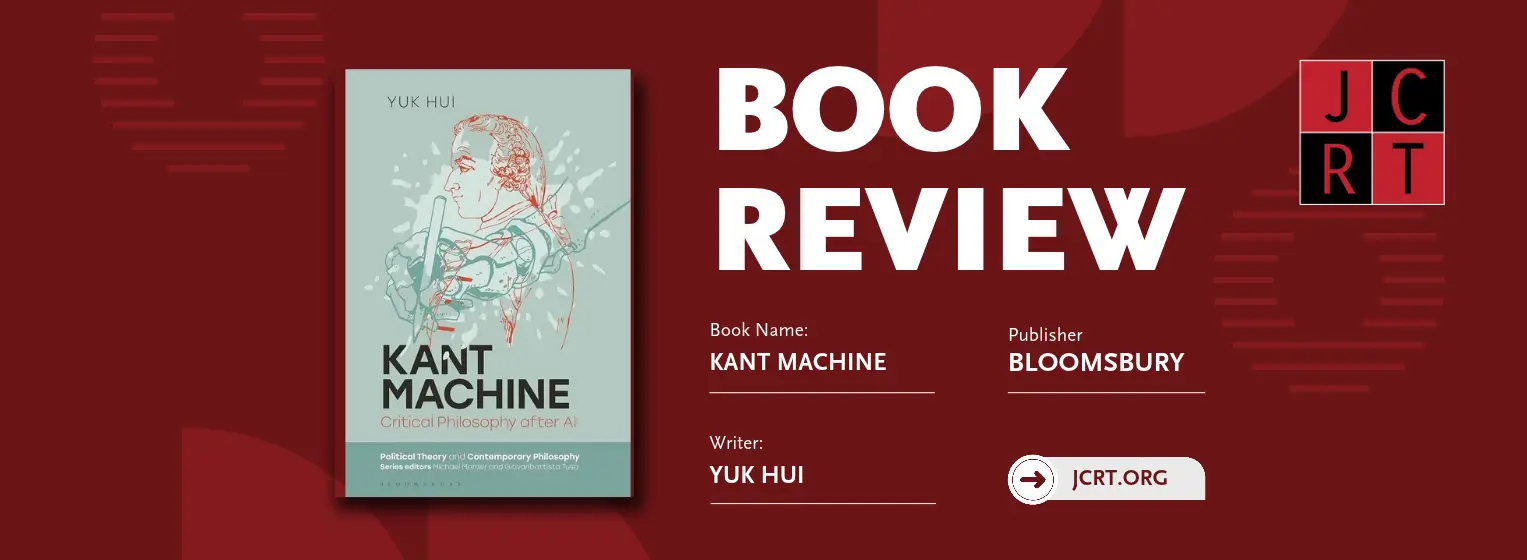
Book Review: Yuk Hui, Kant Machine: Critical Philosophy after AI (London: Bloomsbury Academic, 2026). Paperback, 144 pp., $26.95. ISBN: 9781350602502.
With Kant Machine: Critical Philosophy after AI, Yuk Hui sets out to engage “philosophers who want to engage with AI and the history of philosophy beyond analytic philosophy and cognitive science.” He poses three questions: What could be called an intelligent machine? Are machines capable of being moral? And does an algorithm of perpetual peace exist?[1] Behind all three stands a wager, namely that Immanuel Kant’s critical philosophy, drafted while the first industrial revolution gathered steam, was already an inquiry into the mechanization of reason. Working at the intersection of continental philosophy, media theory, and the philosophy of technology, Hui recovers Kant’s questions about knowledge, morality, and politics in order to draw a boundary around what machine learning, artificial moral agency, and algorithmic governance can accomplish. The wager pays: the book offers one of the sharpest available diagnostics of computation’s limits. Yet, read from the standpoint of practical theology and social ethics, Hui’s account of moral life remains formal and solitary. The gap between the reasoning mind and the formed community is precisely where the diagnostic gives out.
The book’s architecture mirrors Kant’s critical one. In “Intelligent Machine,” Hui asks what kinds of machines deserve the name, contrasting rule-based symbolic AI (heir to Cartesian rationalism) with data-driven connectionist systems (heir to Humean empiricism). Kant’s account of how the mind organizes experience offers the middle path between them, and, in Hui’s hands, that path still explains how contemporary systems learn and adapt. In “Moral Machine,” Hui tackles AI alignment by setting a Kant test alongside Turing’s imitation game: instead of asking whether code can merely simulate ethical conversation, it asks whether a machine can exercise genuine moral self-legislation. As Hui puts it, “after the Turing test, one might propose that the next challenge would be the Kant test: is a machine capable of being moral? … instead of a Moral Turing Test based on imitation, we should consider the Kantian Moral Test as the only veritable test.”[2] His answer deflates the field’s confidence. Genuine moral action requires a freedom and a reflective judgment that resist full calculation; current systems sound fluent and fall short. “Peace Machine” returns to Toward Perpetual Peace (1795) and asks whether platforms can compute a lasting global order. They cannot; code does not resolve the friction and contextual difficulty of political life, the conflict of universals that no algorithm arbitrates: “We have to reaffirm with Kant: conflicts are necessary, but wars are not unavoidable.”[3] Throughout, Hui works by careful philosophical reconstruction, placing Kant in conversation with figures such as Leibniz, Turing, and Norbert Wiener, and the claim holds steady: artificial intelligence remains bound to mechanical and statistical operation.
Readers of Hui’s earlier work on digital objects, recursivity, and cosmotechnics will recognize the project; so will readers of his teacher Bernard Stiegler, who traced how digital tools both support and undermine human attention. Hui extends Stiegler’s concern with the technical organs of memory and care into a direct recovery of Kantian critique, and in doing so he refuses both corporate techno-utopianism and reactive despair. The book presumes real familiarity with “What is Enlightenment?”, the first Critique, and Toward Perpetual Peace; Hui engages these texts with layered attention rather than summary, and he repays the preparation. His greatest strength lies in the refusal to treat Kant as a historical curiosity. Kant’s questions still speak directly to the design of intelligent systems, and the payoff is a claim the AI alignment literature needs to hear: alignment cannot substitute for autonomous moral judgment.
While this formalism is faithful to Kant, it is also the book’s limitation. Moral reasoning, in Hui’s telling, happens almost entirely inside one rational mind. Lived moral agency is embodied, relational, and communal; character and judgment form slowly, in the presence of others, through shared practices and the pressure of real situations. Under conditions of technological acceleration the immediate institutional danger is not the machine that wakes up; the danger is the overburdened human being who outsources high-effort moral discernment to a fluent system. When the necessary friction of relational encounter is removed, the conditions of formation erode, and practitioners (ministers, chaplains, educators, and their secular counterparts) may appear ethically compliant while remaining undeveloped in tested conviction. Because Hui’s framework stays within a largely secular, individualist register, it diagnoses computational constraint with great clarity yet offers few resources for the communal habits and embodied practices that actually protect human agency from automated capture.
None of this unsettles the achievement. Kant Machine is a rigorous, disciplined counterweight to the popular AI safety literature, and scholars in continental philosophy, critical theory, and the theology of technology will find it clarifying; graduate seminars will put it to immediate use. The work that remains, for practical theology and cultural theory alike, is to meet Hui’s diagnostic with the thicker, relationally sustained practices that keep discernment embodied. The machine cannot be argued out of the room; the room can, however, be furnished so that human beings remain the ones who judge.
David Roome
Eastern University
ORCID 0009-0004-1261-7953