

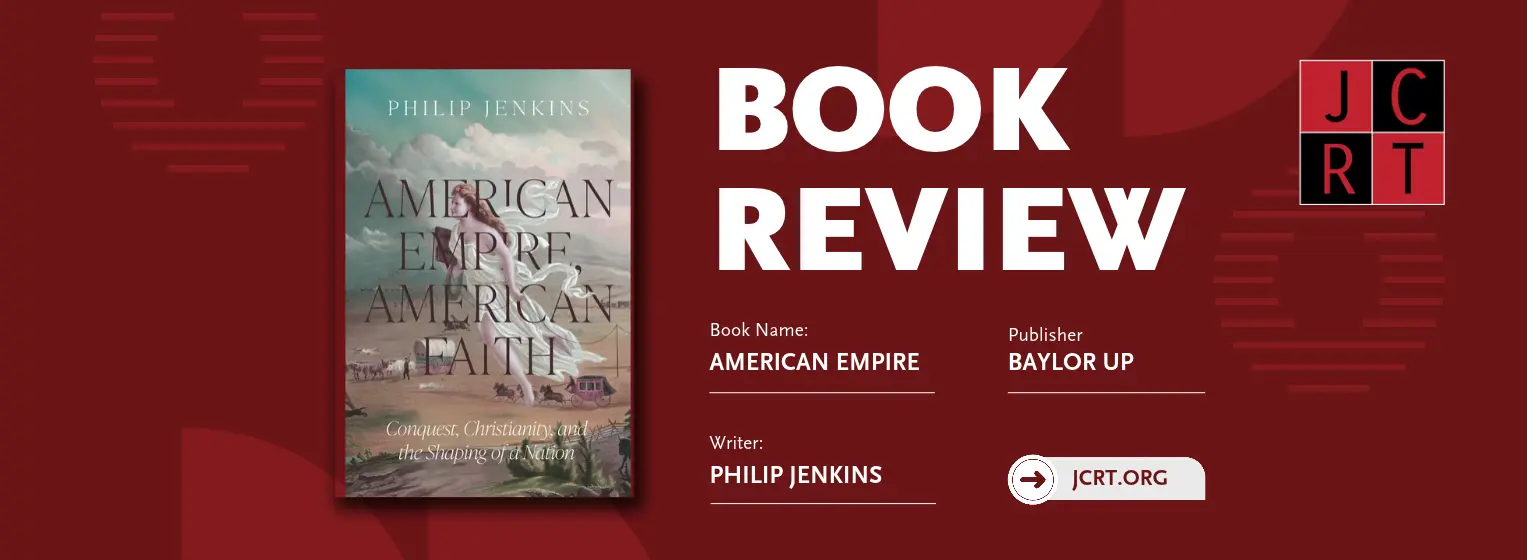
Book Review: Philip Jenkins, American Empire, American Faith: Conquest, Christianity, and the Shaping of a Nation (Waco, TX: Baylor University Press, 2026). Hardcover, $44.99. ISBN: 9781481324250.
1. Introduction
This review examines American Empire, which argues that the United States should be understood not simply as a modern nation-state with global influence, but as an empire whose political power has been shaped, justified, and contested through religious and cultural narratives. Addressing debates in American religious history, political theology, empire studies, and cultural theory, the book first aims to establish what it means to call the United States an empire and then to show how Christianity has interacted with that imperial formation from the era of early settlement onward. Its central claim is that empire is not only a military, territorial, or economic reality; it is also a cultural and moral process through which expansion, hierarchy, and domination become imaginable and legitimate.
In the context of early U.S. settlement, Christianity supplied settlers and political leaders with narratives of providence, chosenness, mission, civilization, and divine purpose that could help frame land acquisition, Indigenous dispossession, racial hierarchy, and continental expansion as morally warranted or historically necessary. At the same time, the relationship is not simply one-directional: American imperial development also reshaped Christianity by giving religious communities new missionary ambitions, national identities, global horizons, and institutional purposes. The book therefore treats Christianity and empire as mutually constitutive—each building upon, authorizing, and transforming the other—rather than as two separate histories that occasionally overlap.
The stakes of this intervention are considerable. By connecting religion to empire from early settlement onward, American Empire asks readers to reconsider whether familiar American ideals of freedom, democracy, exceptionalism, and religious mission may also conceal structures of domination and transnational power. It challenges the tendency to imagine Christianity as either wholly separate from U.S. expansion or automatically opposed to coercive forms of political authority. Instead, it shows that religious language can make power morally intelligible: empire may present itself not as domination, but as liberation, protection, civilization, providence, or service.
I argue that while American Empire makes a significant contribution by defining empire as a cultural and moral formation and by tracing the mutually reinforcing relationship between Christianity and U.S. power, its broader claims depend on how clearly it distinguishes empire as an analytic category and historical process from ordinary nationalism, civil religion, or geopolitical influence. This review will therefore assess not only whether the author establishes the United States as an imperial power, but also whether the book convincingly demonstrates how religious and cultural forms made that power morally legitimate from early settlement through later national development. The book is most valuable for scholars and advanced students of American religion, political theology, settler colonialism, and cultural theory who are interested in the moral worlds through which empire is made durable.
2. Summary of the Argument
American Empire develops its central argument by first establishing empire as more than a formal system of overseas colonies, military occupation, or economic exploitation. The book instead treats empire as a historical process through which political authority expands, organizes territory and populations, produces social hierarchies, and legitimates its own power through cultural and moral narratives. On this account, the United States belongs within the history of empire not simply because it eventually acquired territory or exerted global influence, but because U.S. expansion depended on practices of settlement, dispossession, racial ordering, governance, and cultural transformation that resemble and develop imperial forms of power. The author’s central claim is that religion is not peripheral to this process. Christianity and colonial expansion develop together: religious language helps make expansion morally intelligible, while imperial expansion creates new religious institutions, identities, practices, and ambitions.
The book’s conceptual movement begins by defining empire broadly as a historical system of political expansion and domination in which a power organizes territory and populations through unequal relationships of rule, settlement, dispossession, and cultural transformation. The United States becomes an empire not simply because it acquires land or exercises international influence, but because its expansion depends on settler colonialism and the management of peoples understood as culturally, racially, and religiously different. Christianity is central to this definition because it provides a language through which expansion can be framed as providence, mission, civilization, or salvation rather than domination. At the same time, imperial power produces a religious hierarchy: it authorizes and develops Christian institutions and practices while marginalizing, transforming, or attempting to eliminate Indigenous and other non-Christian religious forms.
A crucial part of this account concerns the unequal treatment of religious traditions. The expansion of Christianity occurs alongside attempts to suppress, replace, discipline, or render illegible Indigenous and other non-Christian forms of religiosity. Colonial power does not merely introduce a new religion into a neutral field; it establishes a hierarchy in which Christian norms are treated as universal, civilized, and compatible with legitimate political authority, while Native religious practices are often marked as primitive, superstitious, threatening, or in need of eradication. The book thus presents religious transformation as one mechanism of empire: the creation of new Christian forms and institutions is inseparable from the marginalization and extinguishing of religious worlds that obstructed or challenged colonial authority.
3. Analytical Evaluation
a) Methodology and Sources
Methodologically, American Empire joins political history to the cultural and religious materials through which power becomes imaginable, morally defensible, and socially durable. Rather than treating empire only as a matter of territorial acquisition, military force, or state policy, the author reads American expansion through the religious narratives that helped interpret it: Christian ideas of providence, mission, civilization, and salvation become central to the book’s account of how imperial authority was justified.
The book’s source base appears deliberately interdisciplinary, drawing together political and governmental records with religious and cultural evidence such as sermons, missionary writings, institutional archives, public discourse, and historical accounts of settlement and colonial expansion. This range is a major strength because it enables the author to place official policy alongside the religious language that made such policy intelligible to settlers, clergy, and other participants in American expansion.
b) Argument and Evidence
American Empire is most effective when it identifies the specific religious mechanisms through which U.S. expansion was justified, normalized, and, at times, resisted. Its key contribution is not simply to describe American activity as “imperial,” but to show how Christian language made imperial power morally intelligible. Ideas of providence, chosenness, civilization, salvation, and mission allowed settlers, clergy, missionaries, and political leaders to frame territorial expansion and the subordination of Indigenous peoples as benevolent, divinely sanctioned, or historically necessary. In these cases, the book demonstrates that religion did not merely accompany expansion; it supplied a moral vocabulary through which dispossession could appear as improvement, conversion as liberation, and political rule as a form of service.
The book connects ideals such as freedom, democracy, civilization, and religious mission to concrete hierarchies of race and power. Although these ideals appear universal in the abstract, they could be distributed selectively: Christian and Euro-American norms became the measure of legitimate religion, political maturity, and fitness for self-rule, while Indigenous and non-Christian peoples were rendered objects of conversion, discipline, removal, or governance. By connecting this moral language to the material realities of settlement, land, institutional authority, and religious suppression, the book shows how imperial power operated through culture as well as through policy.
At times, however, the analysis risks treating “empire” as too expansive a category. If every form of American cultural influence, missionary activity, national aspiration, or international engagement counts as imperial, then the term may lose the precision that gives it explanatory force. A sharper distinction among settler colonialism, formal rule, civil religion, nationalism, and ordinary geopolitical influence would strengthen the argument while preserving the book’s central insight: American empire has depended not only on what the United States has done, but also on the religious stories that have made those actions appear legitimate.
c) Relation to Existing Scholarship
American Empire enters a body of scholarship on American exceptionalism and U.S. empire. Scholars such as William Appleman Williams, Amy Kaplan, Paul Kramer, Daniel Immerwahr, Julian Go, Walter Hixson, and Nikhil Pal Singh have instead demonstrated that U.S. development and global power have been deeply entangled with territorial expansion, colonial administration, racial hierarchy, military intervention, and informal forms of domination. American Empire extends this work by directing attention to religion: its distinctive contribution is to show that imperial power required not only political institutions and economic interests, but also a moral vocabulary through which Americans could imagine expansion as providential, humanitarian, civilizing, or liberating.
The book also belongs in conversation with scholarship on civil religion and political theology. Where work on American civil religion has explored the sacralization of the nation through ideals of freedom, democracy, destiny, and sacrifice, American Empire’s analysis resonates with postcolonial and cultural-theoretical accounts of empire, especially work associated with Edward Said and Ann Laura Stoler, which emphasizes that imperial rule depends as much on culture, knowledge, intimacy, and moral classification as on armies or administration.
The book’s most important conversation partners should also include scholarship in Indigenous studies, Black studies, Asian American studies, and the study of global Christianity. In particular, scholarship on settler colonialism and Indigenous religious traditions raises the question of whether Christianity should be understood only as a legitimating discourse or also as a field that Indigenous peoples strategically adapted, resisted, and transformed under colonial conditions. American Empire opens productive avenues for further work on these questions, especially concerning the relationship between religious freedom and colonial governance, the creation and suppression of religious difference, and the ways communities subjected to American power generated alternative moral worlds.
d) Strengths
The greatest strength of American Empire is its ability to reframe empire as a cultural, moral, and religious structure rather than reducing it to territorial conquest, military intervention, or formal colonial administration. The book shows that American power depended not only on policies enacted by governments but also on narratives that explained expansion as providential, civilizing, humanitarian, or liberating. This approach makes visible the moral work that empire requires: unequal relations of power cannot endure through force alone but must also be made meaningful to those who exercise and accept them. By placing Christianity at the center of this process, the book demonstrates that religion was not merely an afterthought to American expansion but a crucial medium through which imperial power could be imagined as righteous or necessary.
A related strength is the author’s ability to connect large-scale institutions and policies to ordinary moral language and religious practice. The book moves between the formal structures of expansion—settlement, political authority, missionary institutions, education, and the regulation of religious difference—and the language through which those structures entered public consciousness. Christian themes of mission, salvation, providence, freedom, and civilization did not remain abstract theological ideas; they could shape how settlers, clergy, missionaries, and political actors understood land, peoples, and national purpose.
The book is also theoretically useful because it offers readers a vocabulary for recognizing how universalistic ideals can coexist with unequal power. Freedom, democracy, humanitarianism, civilization, and religious mission are often invoked as morally expansive values, but American Empire demonstrates that they can also function selectively, marking Christian and Euro-American norms as universal while rendering Indigenous and non-Christian communities as objects of reform, conversion, discipline, or removal. The historical specificity of the book’s attention to settlement, Christian institutions, and the treatment of non-Christian religiosity keeps this argument from remaining purely abstract.
e) Limitations and Critique
The book’s most significant limitation follows from one of its greatest strengths: its expansive definition of empire. By demonstrating that empire works through culture, morality, religion, and political power, American Empire productively challenges narrow accounts that reduce imperialism to formal colonies or military conquest. Yet the category can become too broad if military intervention, settler colonialism, informal economic domination, missionary activity, cultural influence, and formal colonial rule are all treated as equivalent expressions of a single imperial process. A sharper conceptual distinction among them would strengthen the argument by clarifying what is distinctive about particular moments of U.S. expansion and by preventing “empire” from becoming a label for virtually every exercise of American influence.
A second limitation concerns the distribution of evidence and voice. The analysis would be strengthened by more sustained engagement with the experiences and intellectual worlds of Indigenous communities, colonized subjects, migrants, religious minorities, women, and ordinary laypeople. Such sources would not simply add diversity to the archive; they could reveal how imperial power was interpreted, resisted, adapted to, or redirected by those most affected by it.
Finally, the book’s broad historical scope risks flattening important differences among distinct eras of American power. Continental settlement and Indigenous dispossession, overseas colonial administration, Cold War intervention, and the contemporary security state share family resemblances, but they involve different legal regimes, racial formations, institutional mechanisms, and religious justifications. When the analysis moves rapidly across these periods, it can imply a continuity that is more seamless than the historical record allows. A more differentiated chronology would make the book’s central insight even stronger by showing not merely that Christianity and empire have long been intertwined, but how the relationship changed as the forms, targets, and legitimating languages of American power changed.
4. Conclusion
Despite its limitations, American Empire is best understood as a strong interpretive intervention into the relationship among Christianity, U.S. power, and imperial expansion rather than as the final word on American empire. Its central achievement is to insist that empire must be studied not only as a military, territorial, economic, or administrative reality, but also as a cultural and moral formation. By placing Christian narratives of providence, mission, civilization, salvation, and freedom alongside histories of settlement, dispossession, racial hierarchy, and expansion, the book makes clear that the American empire has depended on more than political institutions or force alone. It has also depended on religious stories that make unequal arrangements of land, race, authority, and belonging appear legitimate, benevolent, or historically necessary.
The book is especially valuable for scholars working in American religious history, political theology, cultural theory, U.S. history, postcolonial studies, and religion-and-politics research. It offers a useful framework for asking how religion relates to political power without reducing Christianity either to a private sphere isolated from public life or to a uniform instrument of domination. It makes Christianity and empire appear as mutually constitutive: Christian institutions and moral vocabularies could authorize expansion and hierarchy, while imperial projects reshaped religious identity, missionary ambition, institutional practice, and national self-understanding. This emphasis makes the book a particularly useful corrective to accounts of American religion that neglect settler colonialism, global power, and the suppression or transformation of Indigenous and non-Christian religious traditions. The book would work well in advanced undergraduate and graduate seminars on American religion, empire, nationalism, race, civil religion, political theology, settler colonialism, and global Christianity.
Ultimately, the lasting value of American Empire lies in its challenge to readers to examine the moral narratives through which power appears universal, benevolent, or necessary. Its limitations do not negate that contribution. Rather, they identify questions that future scholarship must pursue: how have different communities experienced, resisted, adapted to, or redirected the religious worlds of American power; how have the mechanisms of empire shifted from settlement to overseas intervention and the contemporary security state; and under what conditions can religious ideals of freedom, mission, or democracy become resources for genuine liberation rather than languages of domination?
Kev Grane
University of Denver
JCRT Readers can receive 20% off at baylorpress.com using code “17Promo”.